This blog is the first part of our visit to the Azores.
In September we took a 2-week holiday in the Azores. We knew nothing about the destination, and that was a large part of the attraction. A scan with a computer soon gave us basic information, and having made the necessary bookings, we were off.
The Azores are an archipelago of nine volcanic Island in the Atlantic, about 1500 kilometres west of Morocco. The oldest islands are Santa Maria in the southwest at 8.5 million years and Sao Miguel at 4.1 million years. Sao Miguel was formed over a long period by the eruptions of 5 separate volcanic events over millions of years. This gives it the most diverse environments of all the islands.
The Azores is an autonomous region of Portugal with its own legislature in Ponta Delgado. We began and ended our holiday on Säo Miguel, the largest island in the Azores. We would not have time to visit all the islands and we planned to spend time on the three islands of Säo Miguel, Terceira, and Pico.
We flew directly from Zurich to Ponta Delgada, the capital of the Azores, on the island of Säo Miguel. We arrived at midnight and went straight to our hotel in the old quarter, where we stayed for that night and the next. The hotel was a converted from a former monastery, but has been through several transformation before this.
We had only one day Ponta Delgada and so we were up early in the morning to make the most of the day. We went on a walkabout of the port and the old town.
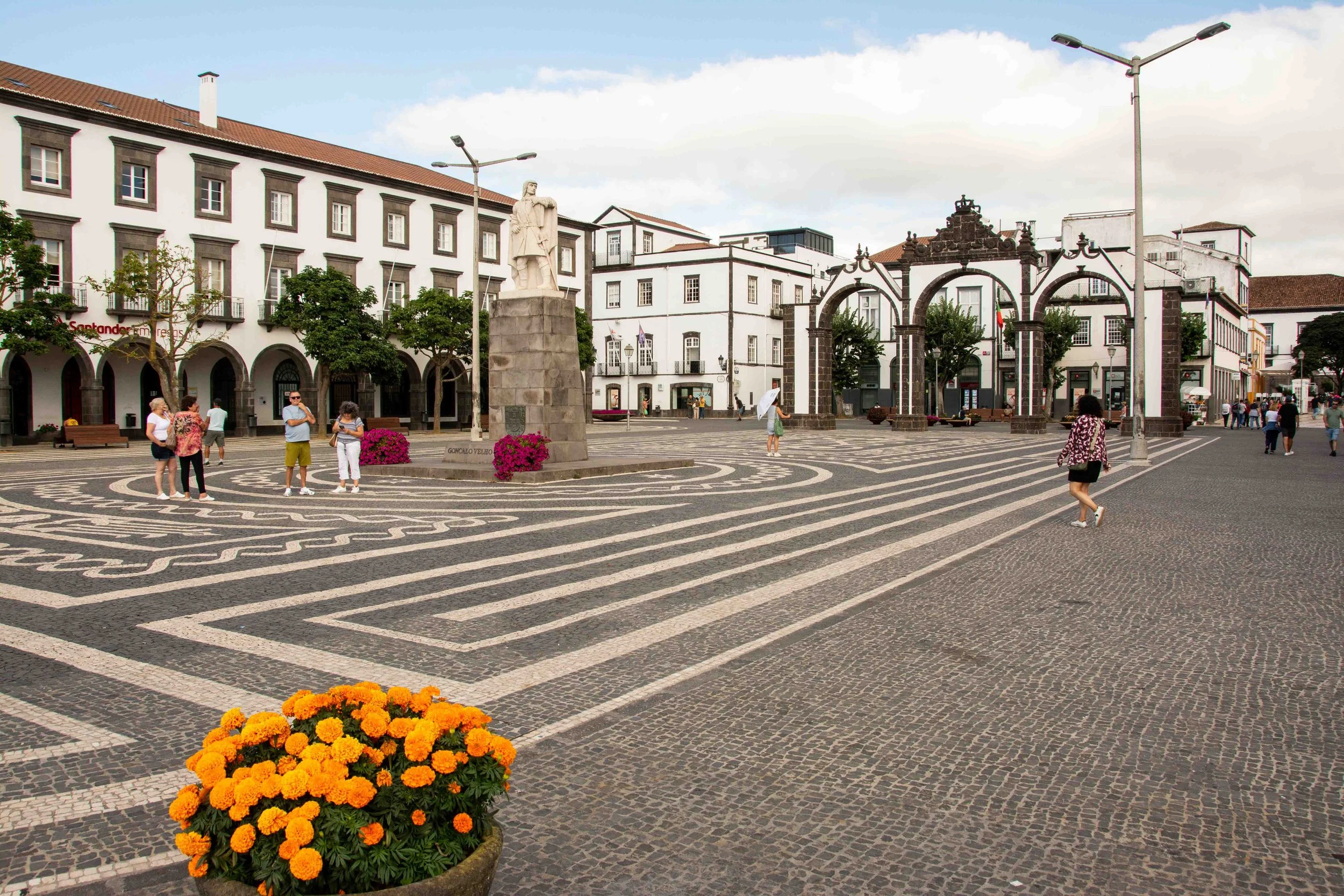
1. The central square with the 3 arches of the Portas da Cidade - the gates to the city
The central square introduced us to what was to become familiar to us, the simple but effective black and white of most buildings, both private homes and public buildings. The pavements everywhere are made of black and white cobbles, known Calçada Portuguesa (Portuguese Pavement), laid in intricate patterns. The black comes from the basalt that makes up most of the Azores and the white is usually a limestone.
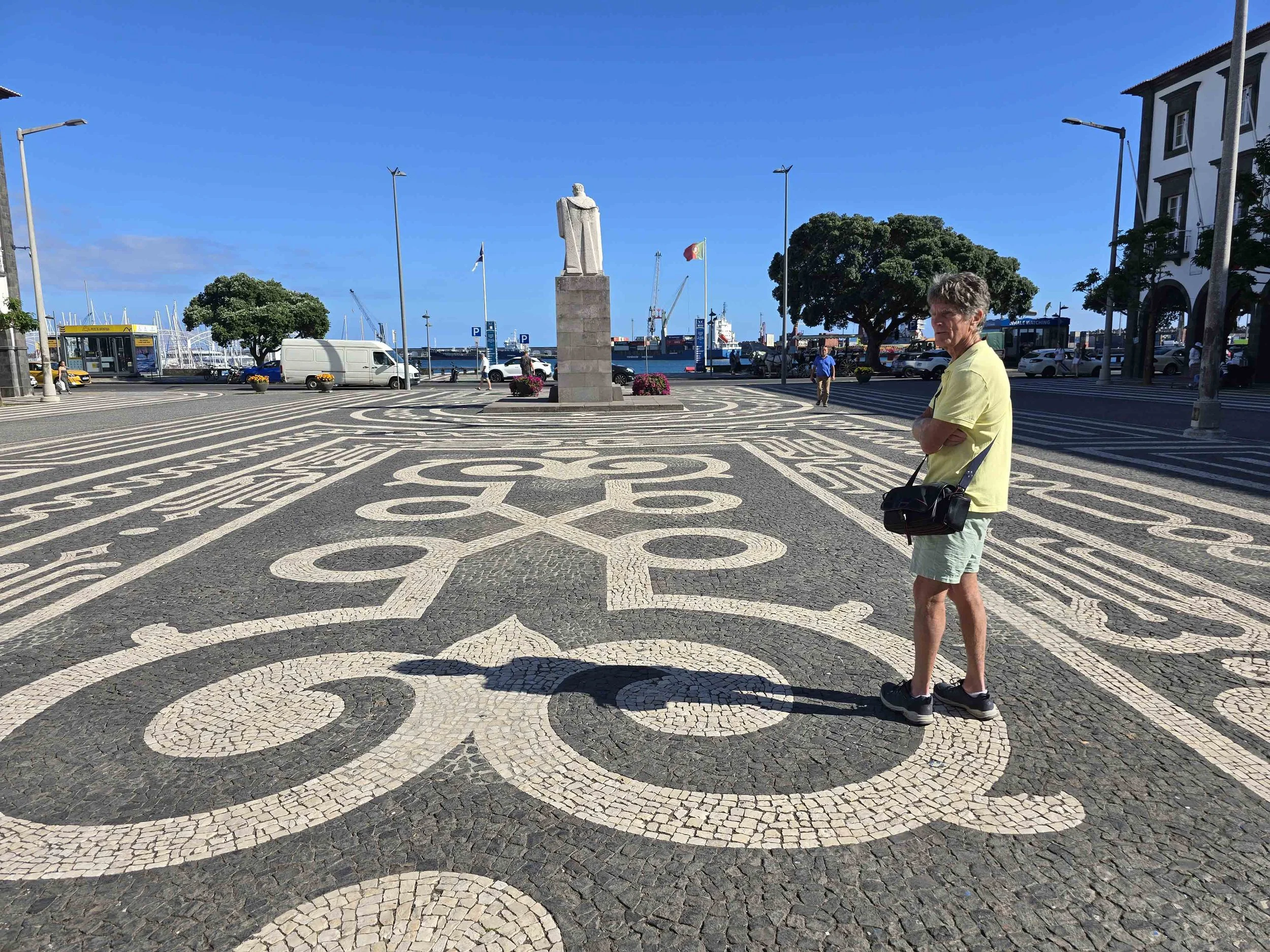
2. A complex Calçada Portuguesa
The old town is situated around the port and small boat harbour; the Azores is a stopping off port for many yachts crossing the Atlantic to the West Indies and the Americas.
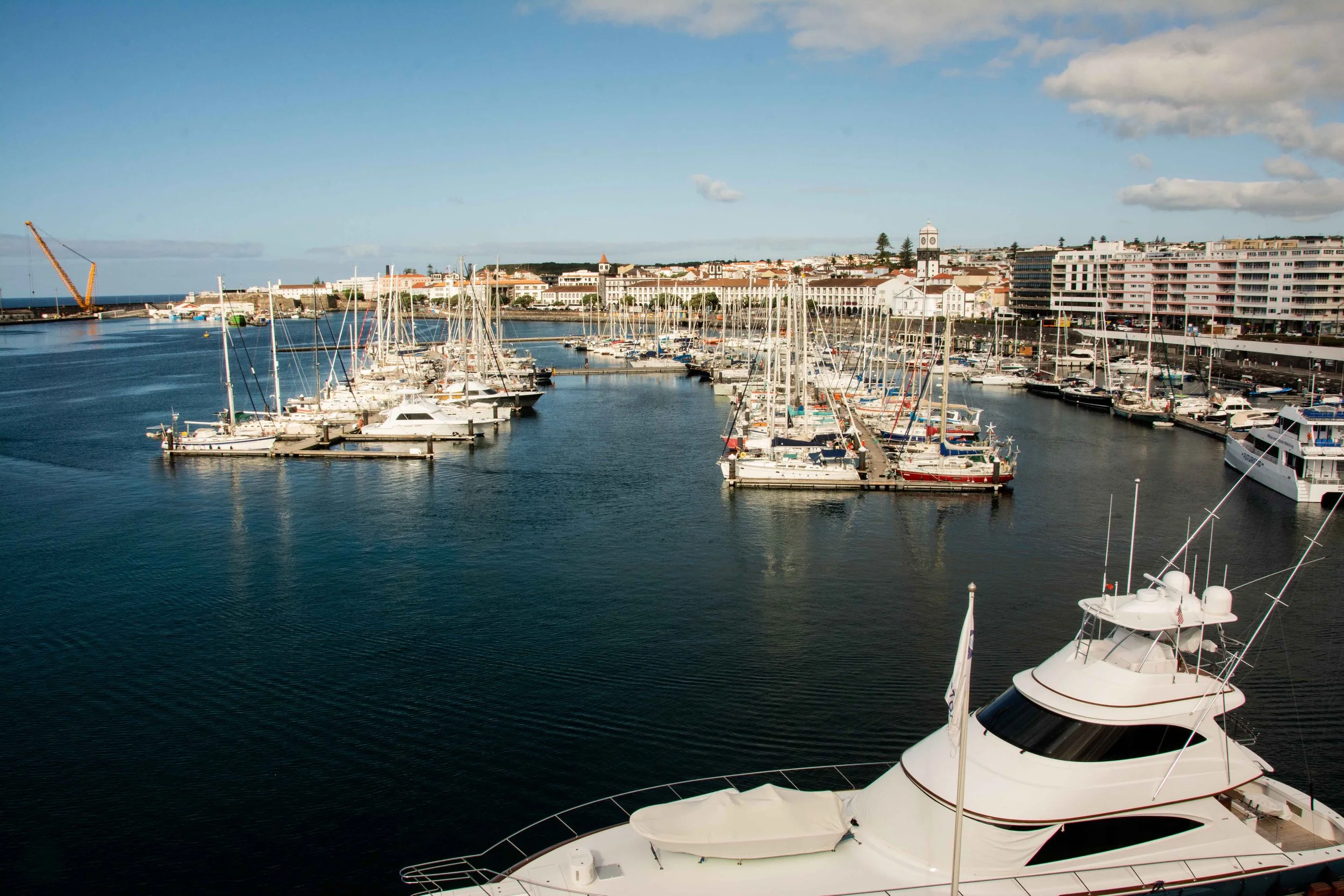
3. The yacht basin in the port
There is a long and broad, curving promenade overlooking the yacht basin and lined with tempting cafes and bars. We walked the length of it and then strolled the narrow streets of the old town. Here we became acquainted with the religious on the motifs on the walls of many if not most of the houses
In the heat of the day, we returned to the hotel and lazed around their pool.
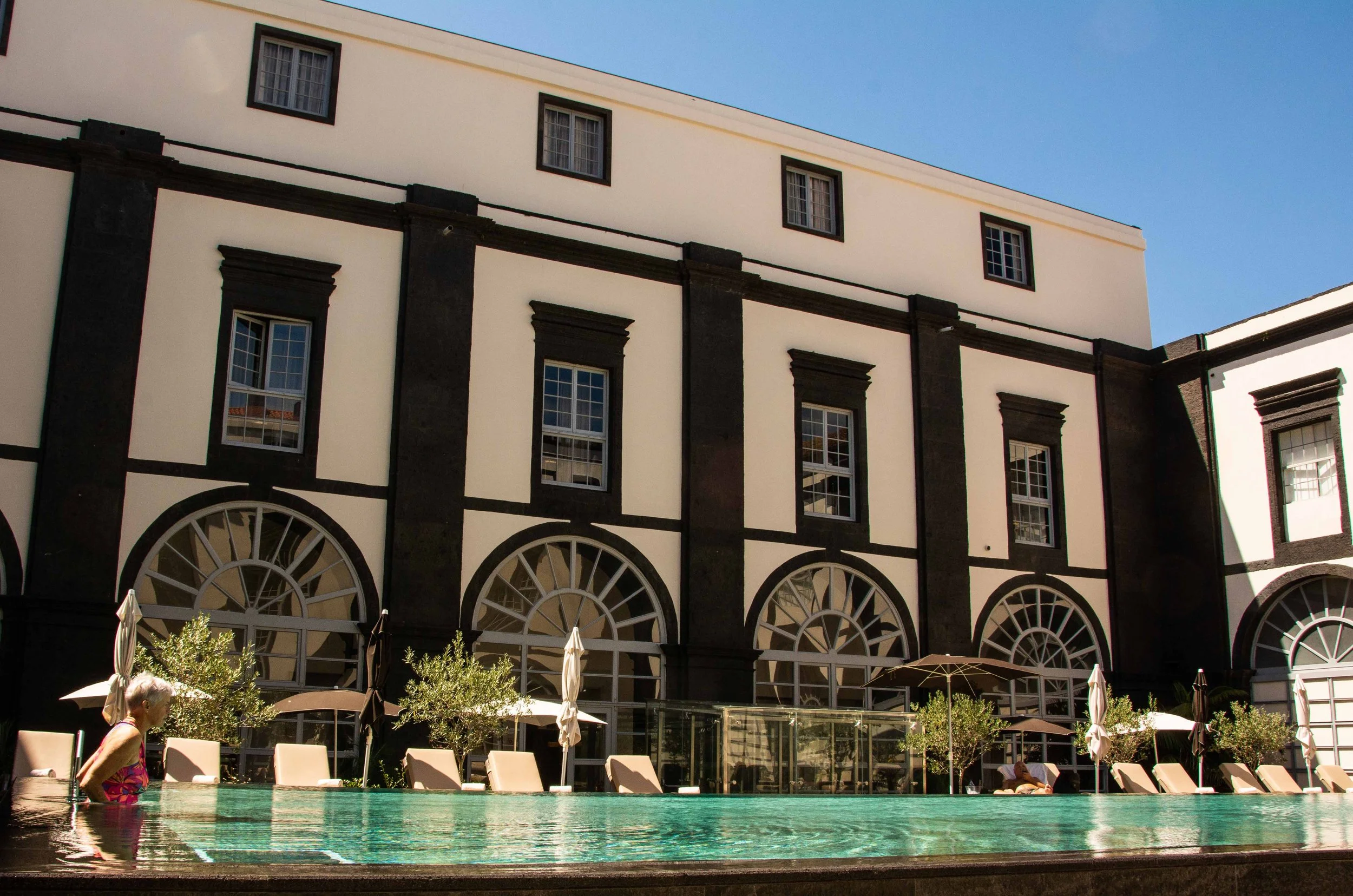
4. Enjoying the pool
In the late afternoon we went for a beer at one of the many bars along the promenade. Part of the port basin is cordoned off with buoys and is a popular swimming area
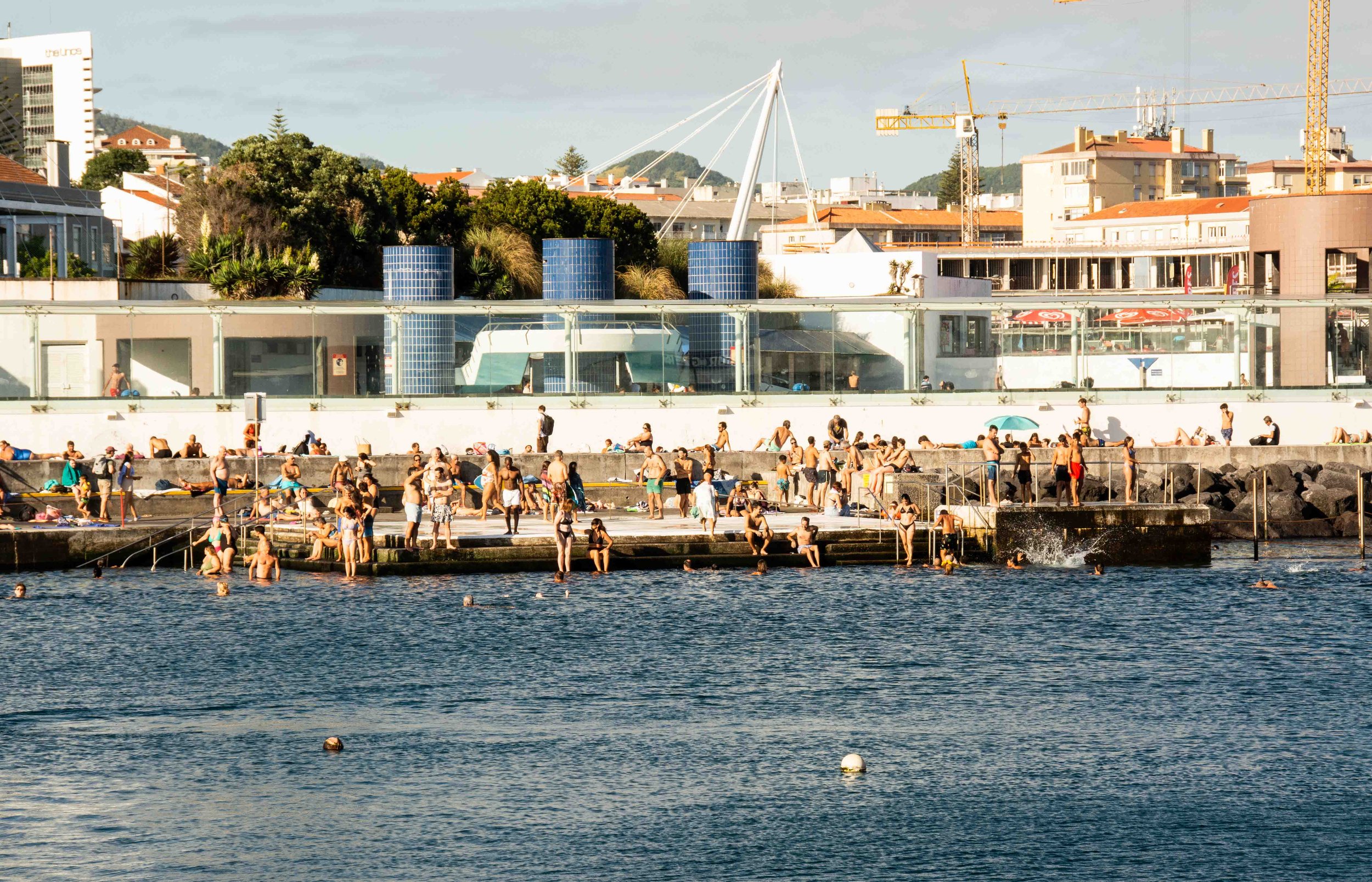
5. The people of the Azores take every opportunity to swim in the sea. The maritime heritage.
Everywhere we went on the islands these, religiously themed tiles were decorating houses.
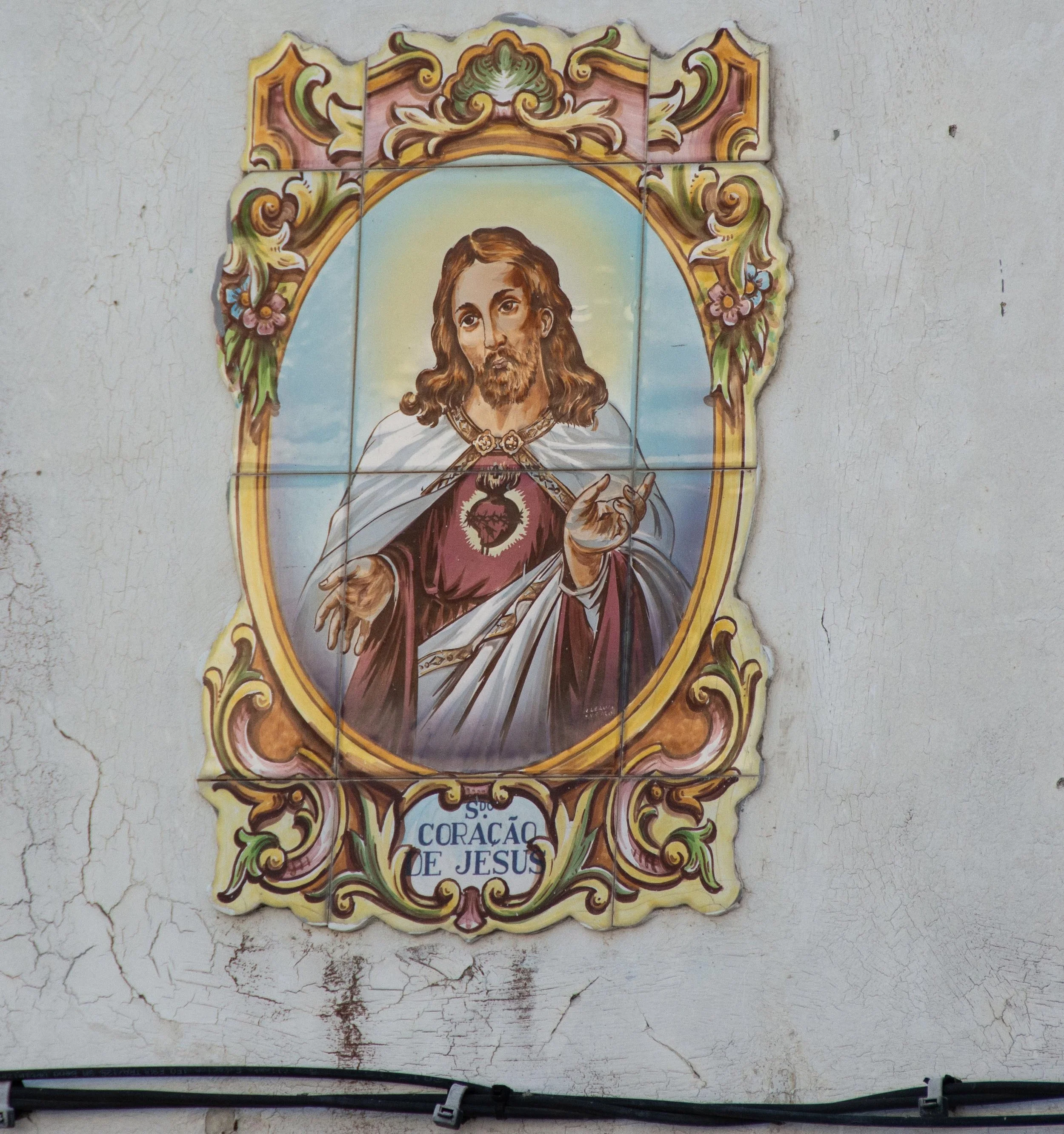
6: I don’t know what the correct term is, icon doesn’t seem quite right, but so many houses had this type of decoration on the front wall.
In the evening we went to a small restaurant we had seen during the day. Excellent food and I had grilled limpets as a starter. Never had them before, but I will grill them myself when given the opportunity. The next morning we were up very early to catch our flight to the island of Terceira
TERCEIRA
On Terceira. we rented a fairly battered car from Herz and drove to our B&B. The B& B was not much to look at but was very comfortable. Terceira is famous for the hortensias lining their roads but we were a bit late in the season and they were past their best. Many of these roadside hedges are well over head height and must be lovely to see when they are in full flower. But, and it is a big but, they are also a pest plant, covering hill sides in some places
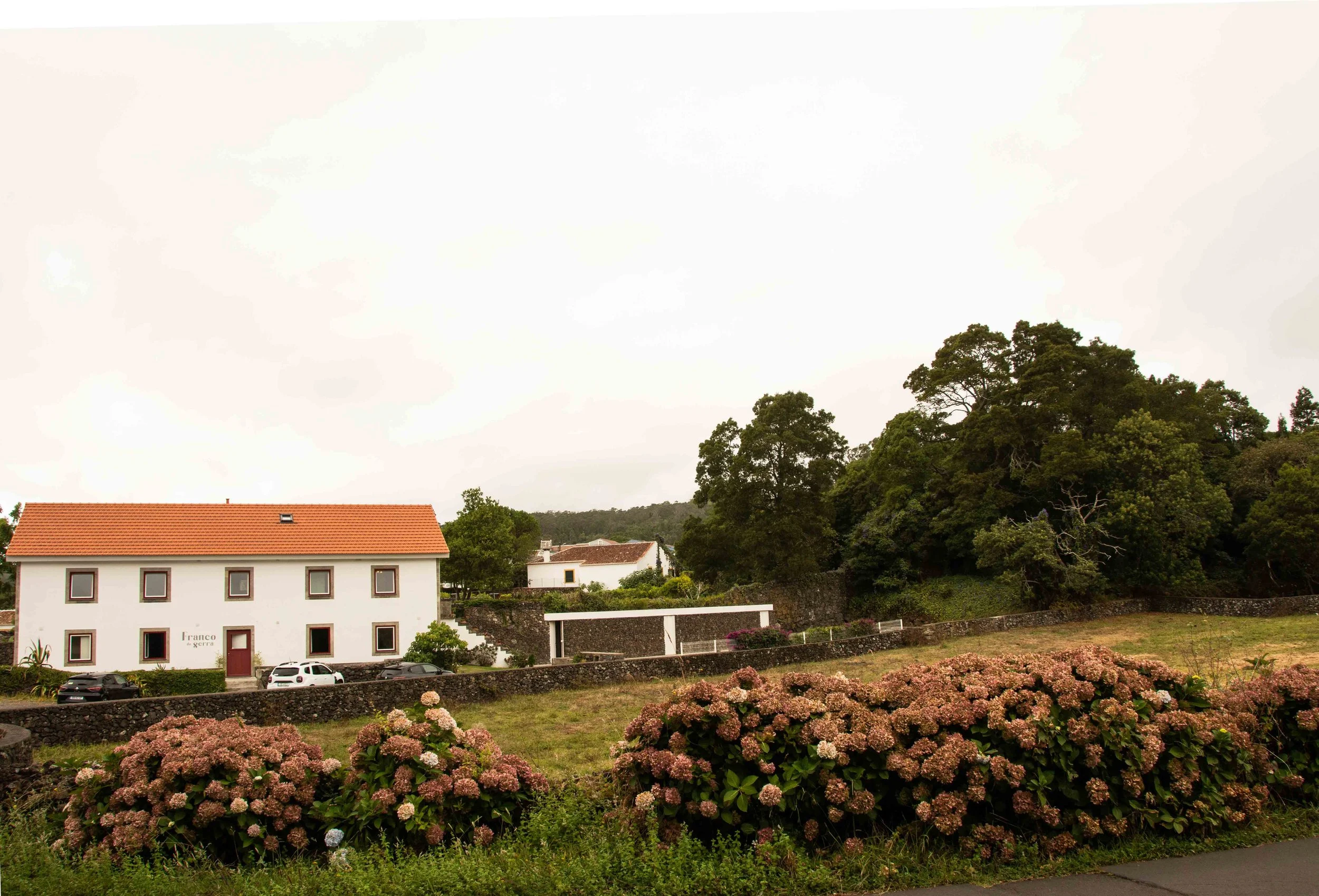
7. Our B&B with hortensias. Although they can look lovely hedging the roads, hortensias are a pest species, sometimes covering hillsides.
The view from our B&B also gave us our first view of the drystone walls that we were to see everywhere we went. Almost all the walls on the three islands we went to were made from black basalt, some stretching for kilometres. The rock is the basic building material of the Azores and is also used for building, although most houses have been plastered.
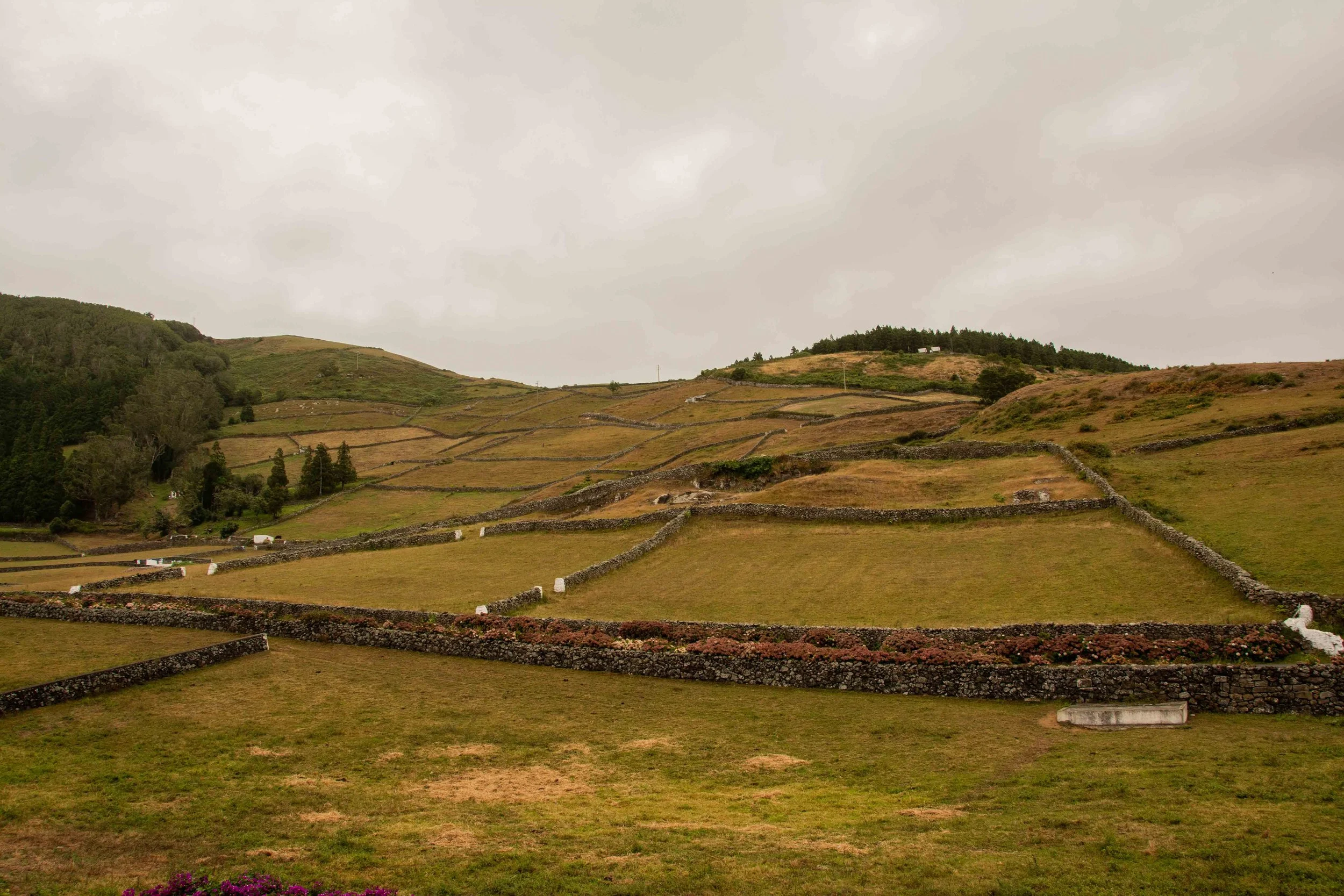
8 Drystone walls marching up the hills.
Once we had settled in, we went for a drive to the coast and the town of Biscoitos where we swam in the rock pools. The swimming areas are basically gullies in the basalt, with concrete walkways linking them, with stainless steel ladders and rails where necessary.

9. A series of intersecting gullies make for a popular swimming area protected from the Atlantic swells.
Really well done and as we were to discover, most coastal villages have something similar. For those who know the western Cape in South Africa they reminded us of old Onrus and Hermanus with small whitewashed houses and narrow streets.

10The view across the Atlantic gives the illusion of the horizon being bigger than anywhere else. It seems to stretch forever.
The next day started overcast and drizzly. An island in the mid-Atlantic is bound to be wet, and we went driving to a port and lighthouse. On the way we stopped at a small wetland where we did a little bird watching. Surprisingly good, Sanderlings turnstones, godwit, terns, gulls, sparrows, doves, in what was barely more than a piece of industrial wasteland.
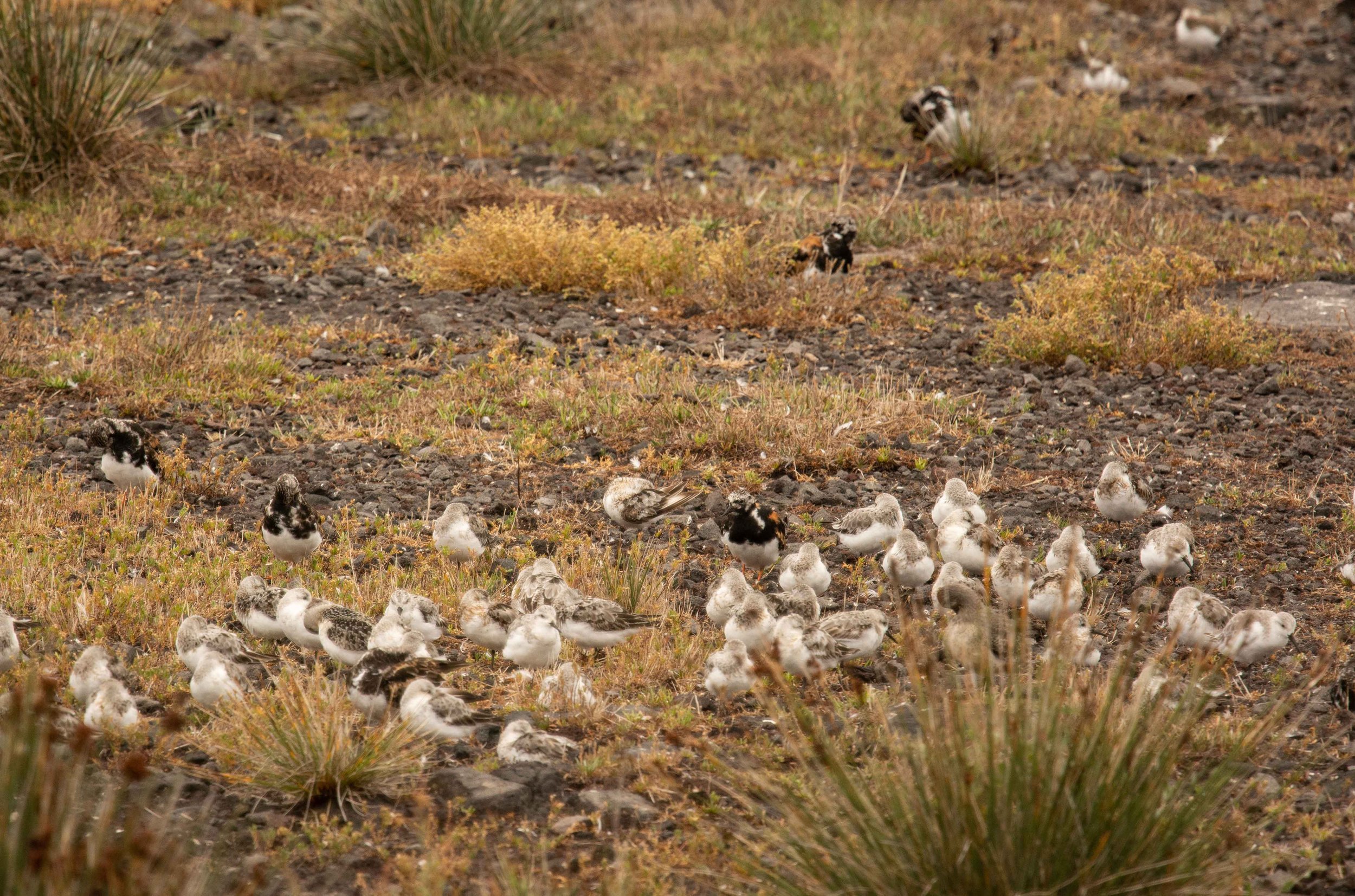
11: Sanderlings and turnstones
At Praia da Vitoria we stopped for an ice-cream on the promenade, the sun had come out and the day was warming up. Fishing has been an important to the islands and wherever there is a suitable bay there is a small harbour. Nowadays fishing seems to have declined a bit, and the harbours are filled with yachts and pleasure boats.
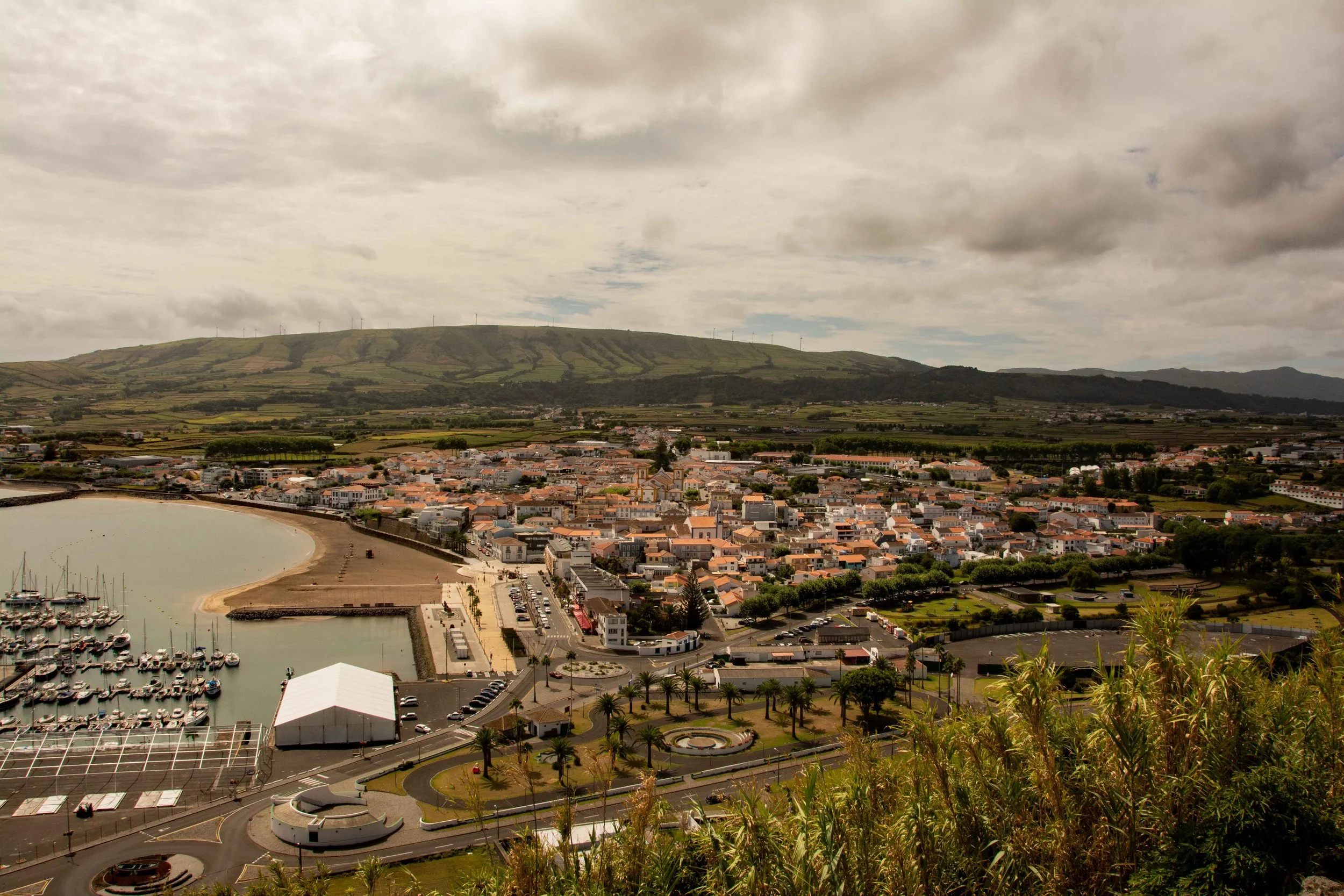
12. Overlooking the town of Praia da Vitoria
There is an imposing monument to Mary overlooking the town and harbour. We briefly considered walking up the hill to it, but better sense prevailed and we drove up.
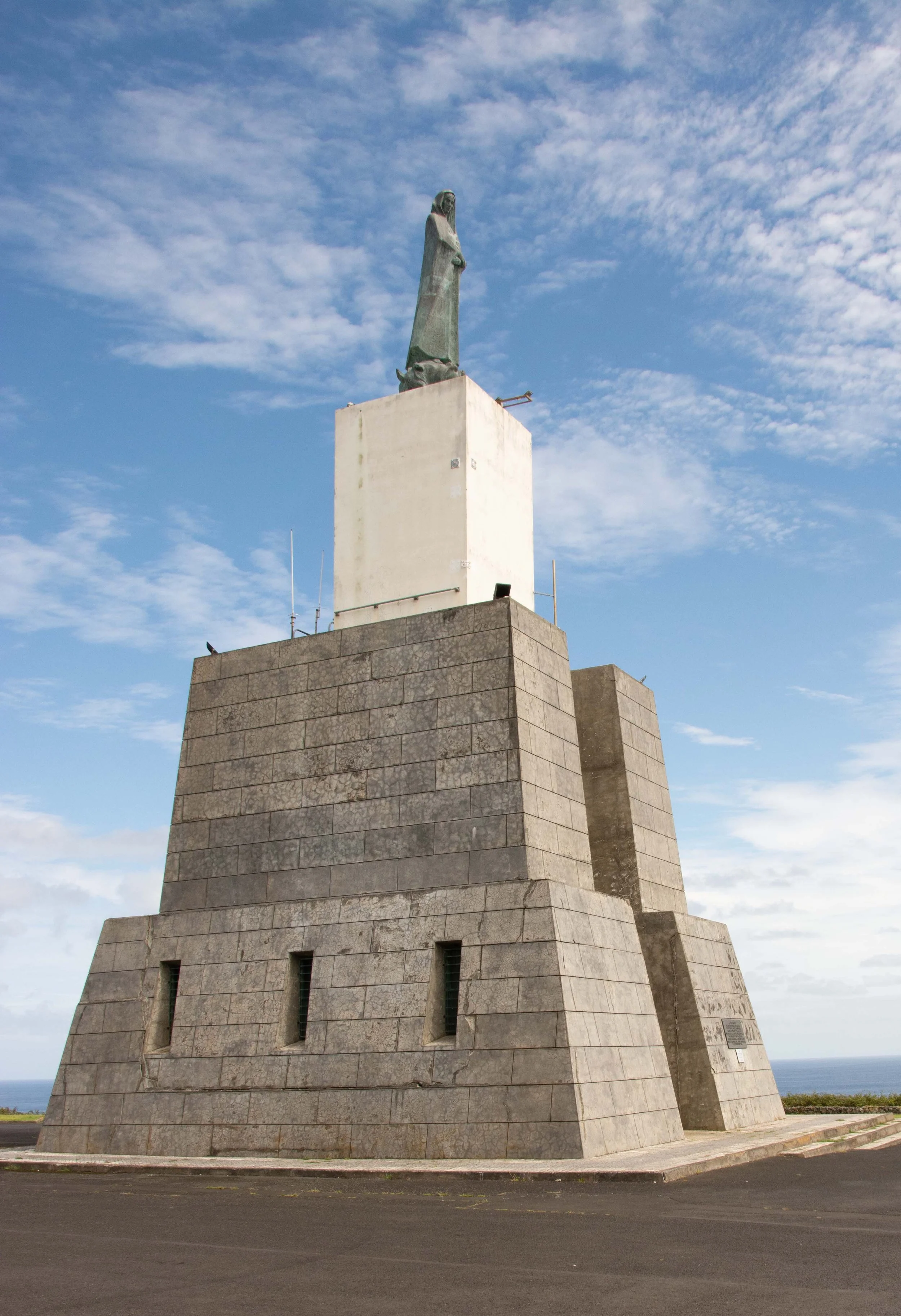
13. The massive statue of Mary has an authoritarian feel about it.
The view over the caldera, 9 kms in diameter, was spectacular with the impressive drystone walls stretching into the distance.
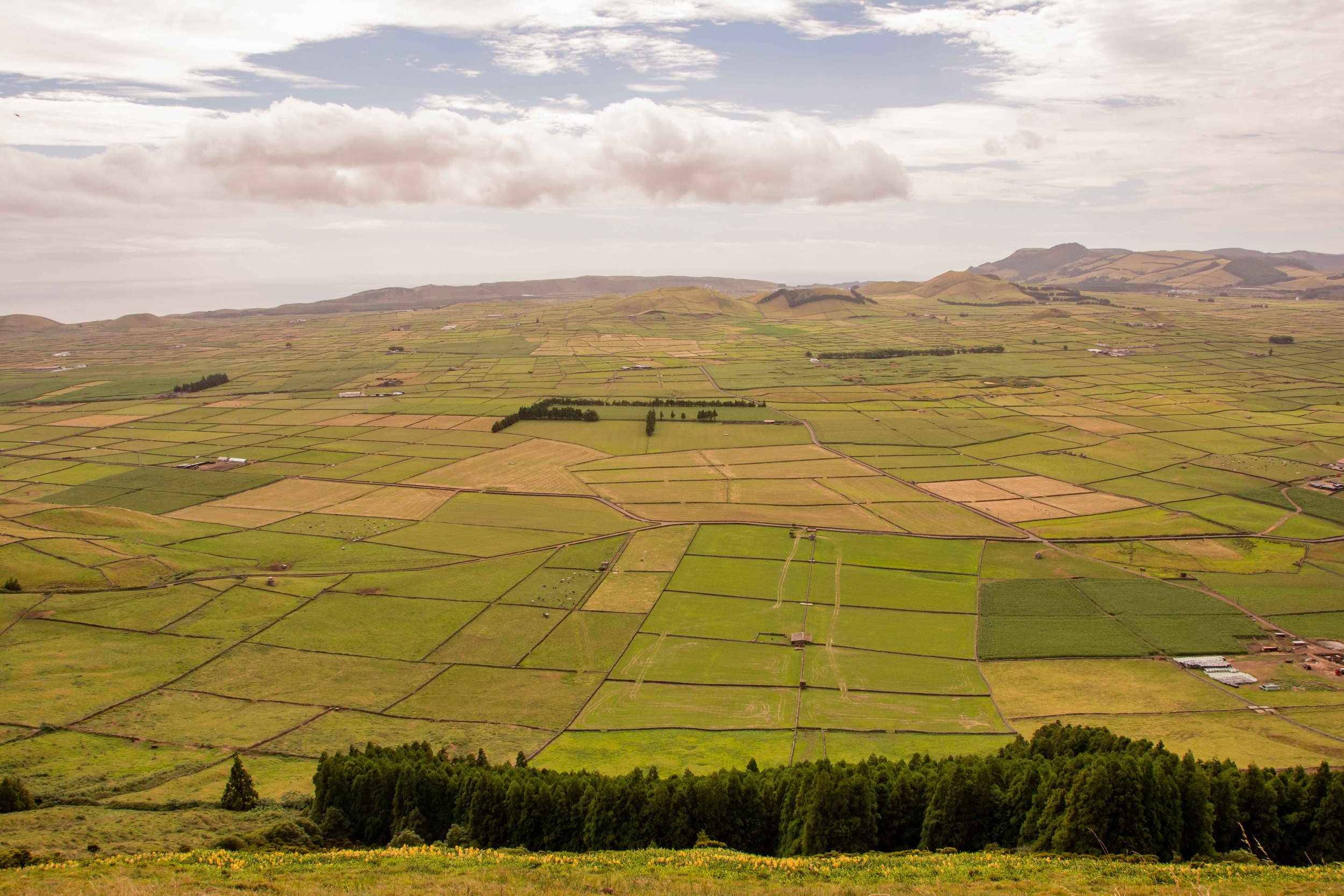
14. Drystone walls completely dividing up the caldera into farm fields
We tried to avoid too much driving and wherever we could we stopped to walk and explore the countryside and coast. There were a battles fought over the Azores as they were an important supply port for boats sailing to the Indies and South America.
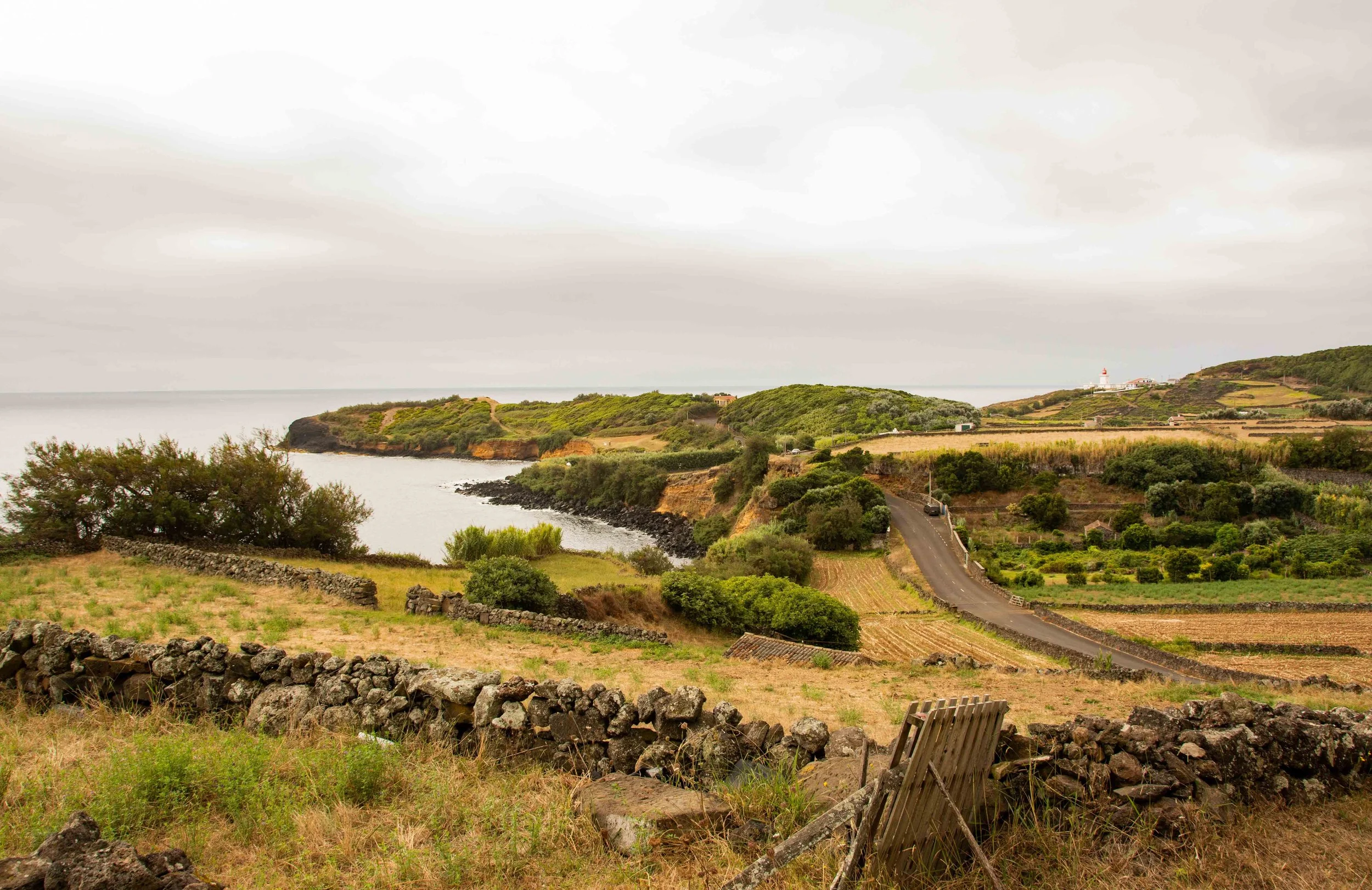
15. This collapsing gate and disintergrating wall was the start of a walk to the remaining fragments of what had once been a fort guarding the island.
In the evening we drove to the harbour town of Sao Mateus and the Baia restaurant where I had a whole red snapper and Ursula had octopus salad and a game fish, like tuna, but we did not know the name. Excellent
The next day, our fourth day on Terceira, started sunny and we decided on a walk up the slopes of a large caldera before going on to see the fumaroles for which the area is famous. An energetic but not too strenuous walk took us through the Japanese Cedar forest to the top
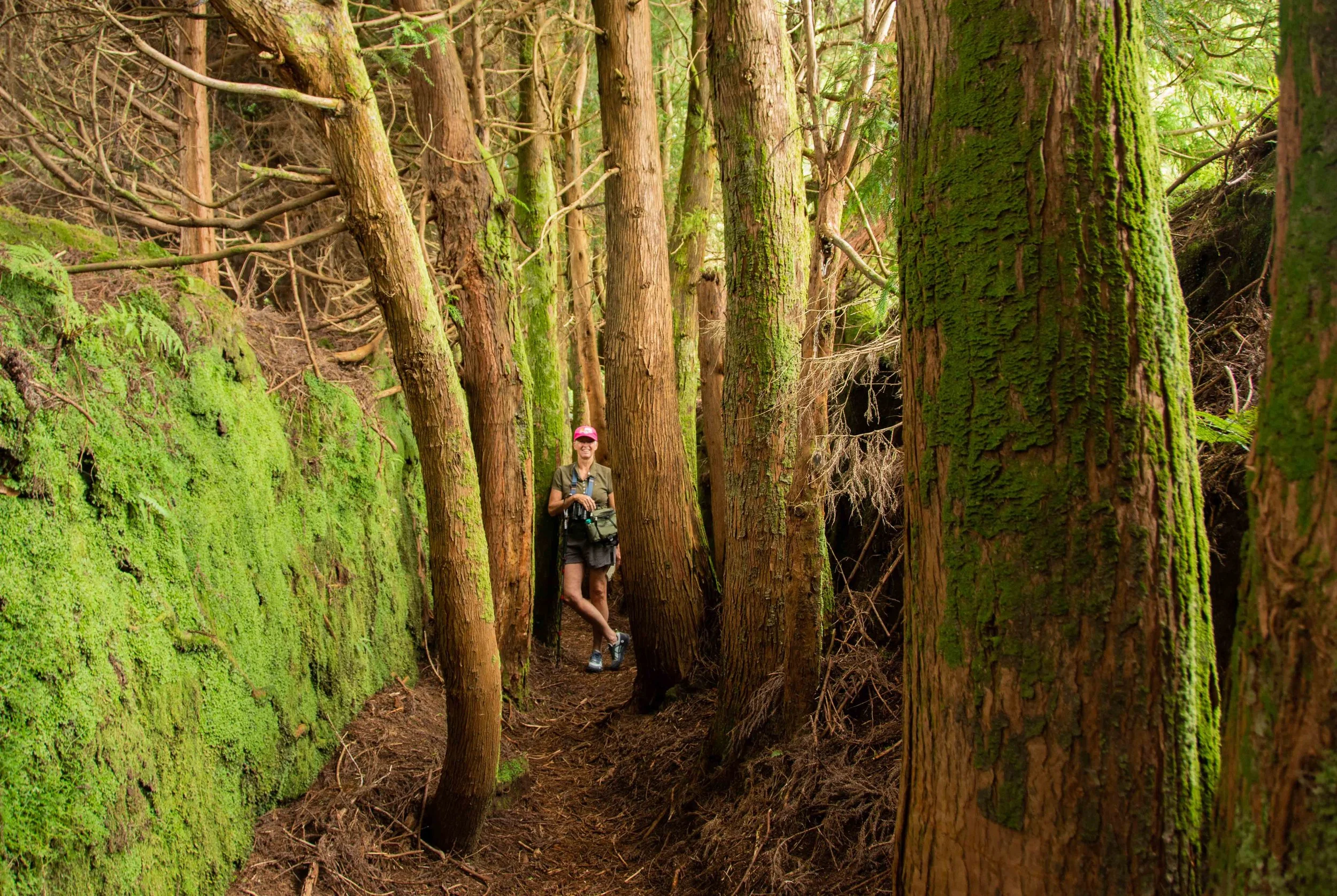
16. The lower slopes are covered with a Japanese Cedar forest, another introduced species.
From the ridge at the top where we had an impressive view of the floor of the caldera 4 or 5 kilometres across, the cattle farms, and the inevitable drystone walls.
From there we went to Furnas do Enxofre, an area famous for its many fumaroles. It is a protected area and as you walk through on well maintained paths there are vents large and small wherever you look. The main vents have a distinct sulphur smell, but not so strong as to be unpleasant.
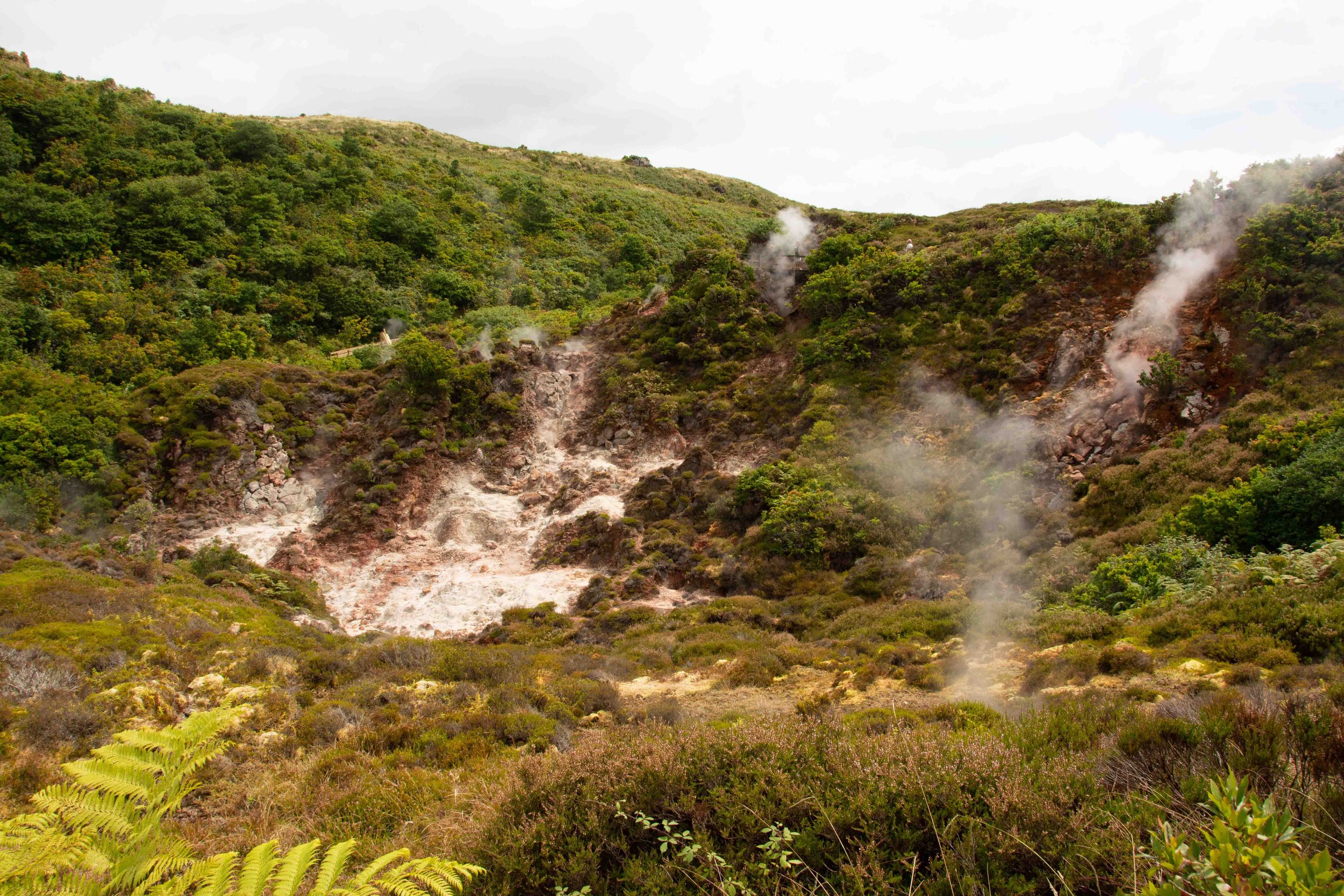
17. Steam seeping from the ground wherever you looked.
The volcanic nature of the Azores means that over most of the islands the basalt drops steeply into the sea and there are only a few areas with a sandy beach. A few meters from the shore and you are out of your depth and this makes it for good snorkelling and fishing and means that you can throw yourself into the water almost anywhere.
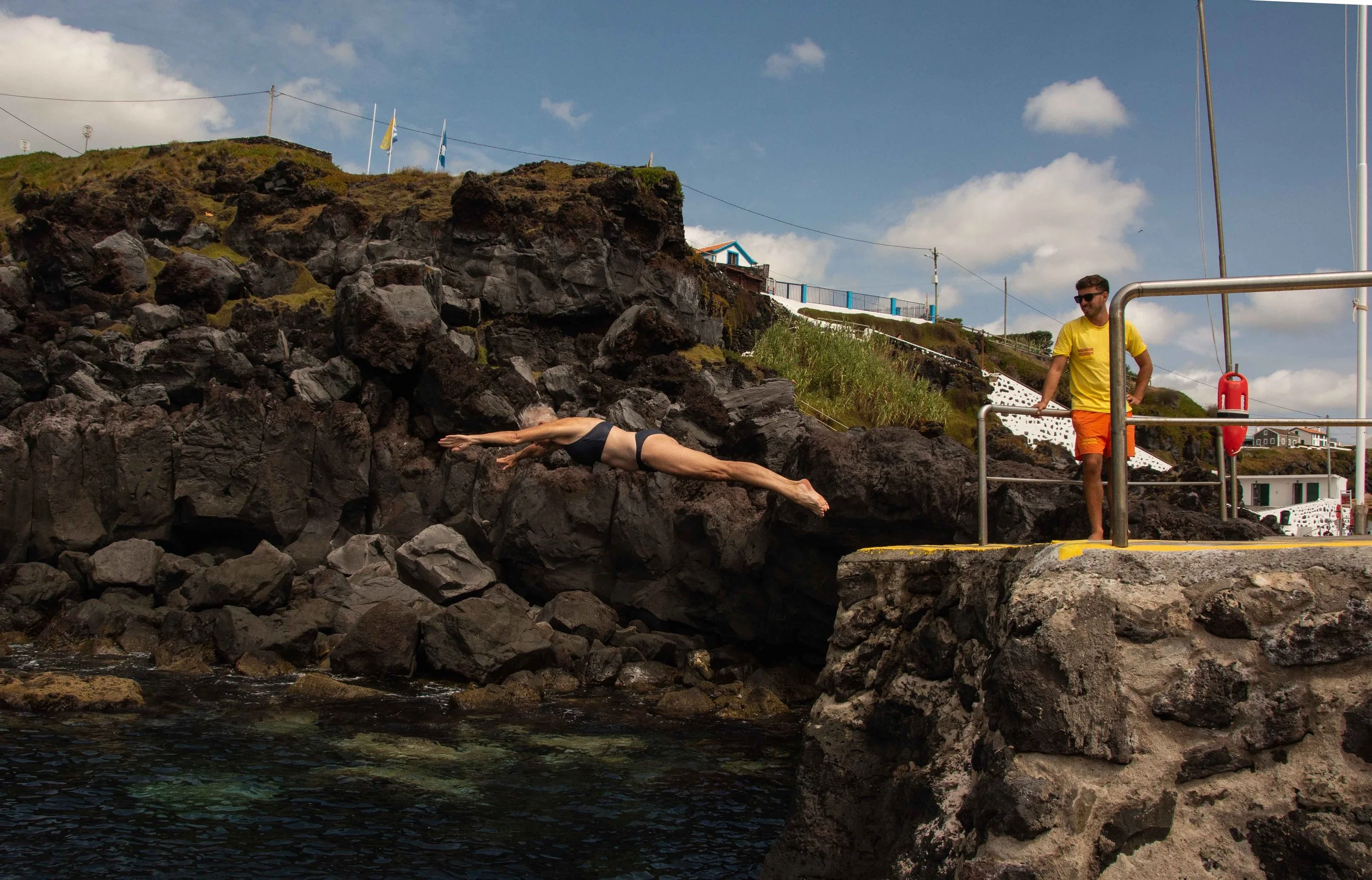
18. Ursula diving into the deep water only a few meters from the shore, watched over by a lifeguard
After 3 days on Terceira we moved on, and flew to the island of Pico where we were to spend the longest time of our trip.
PICO
We flew to Pico on our fifth day on the Azores. We picked up our hire car, a small Citroen, at the airport and drove to self-catering, the Casa dos Botes,a boathouse converted into two apartments, at São Caetano bay. We did not have the front apartment, a blessing it turned out as the parking lot became quite busy.
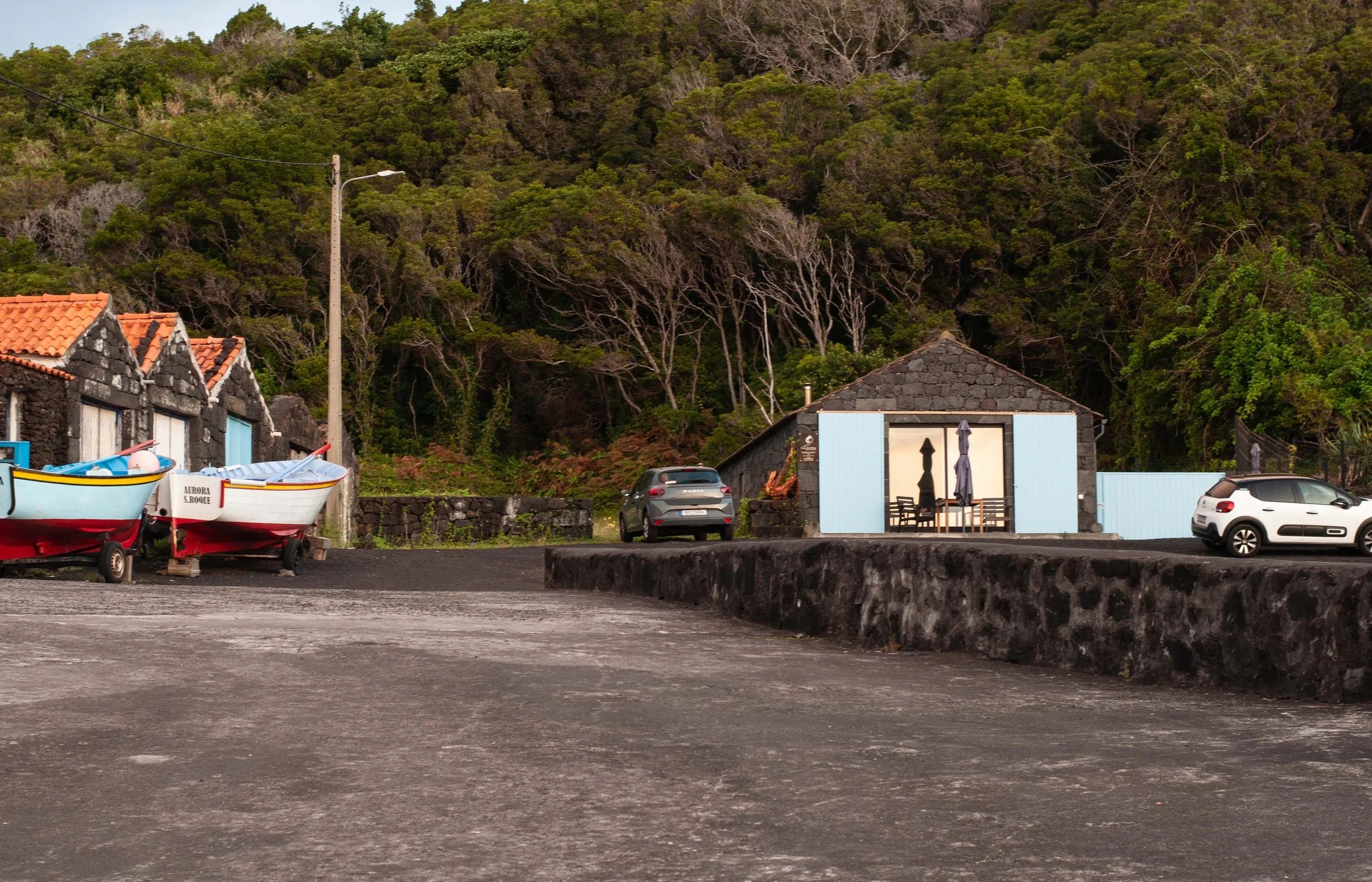
19. Casa dos Botes. Two boats on the left and the basalt built converted boathouse between the cars.
There was a small swimming pool in the rocks, chest deep at high tide, with concrete sunning area, and also also a slipway and jetty for small boats. The best swimming is off the jetty wall.
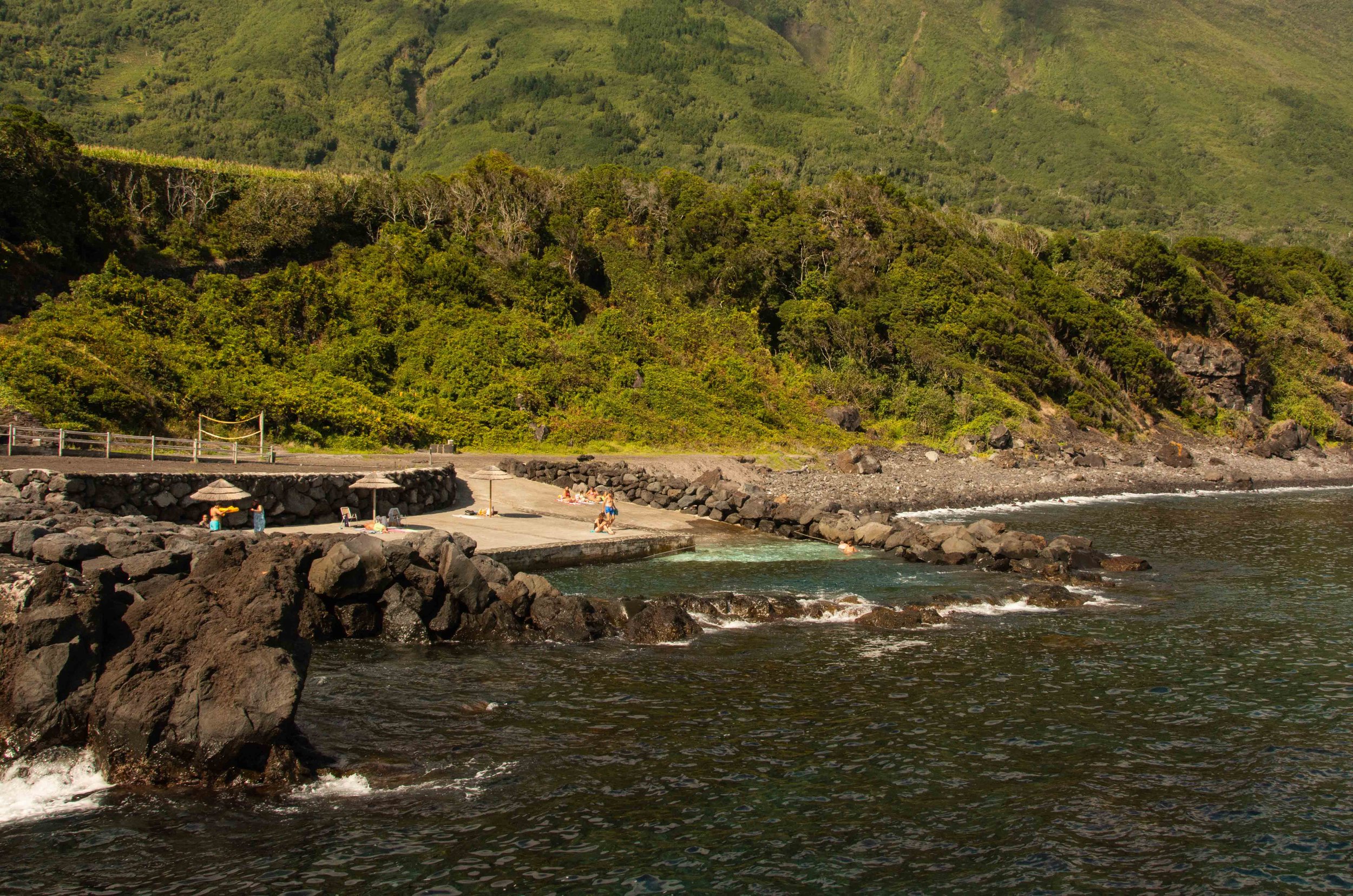
20. The swimming pool at low tide. At high tide waves break over the rocky wall in front
Next to the parking lot there is also a café serving beer, wine, and ice-cream, and with a TV where fishermen and others gathered to watch TV after fishing, sometimes fairly late into the night.
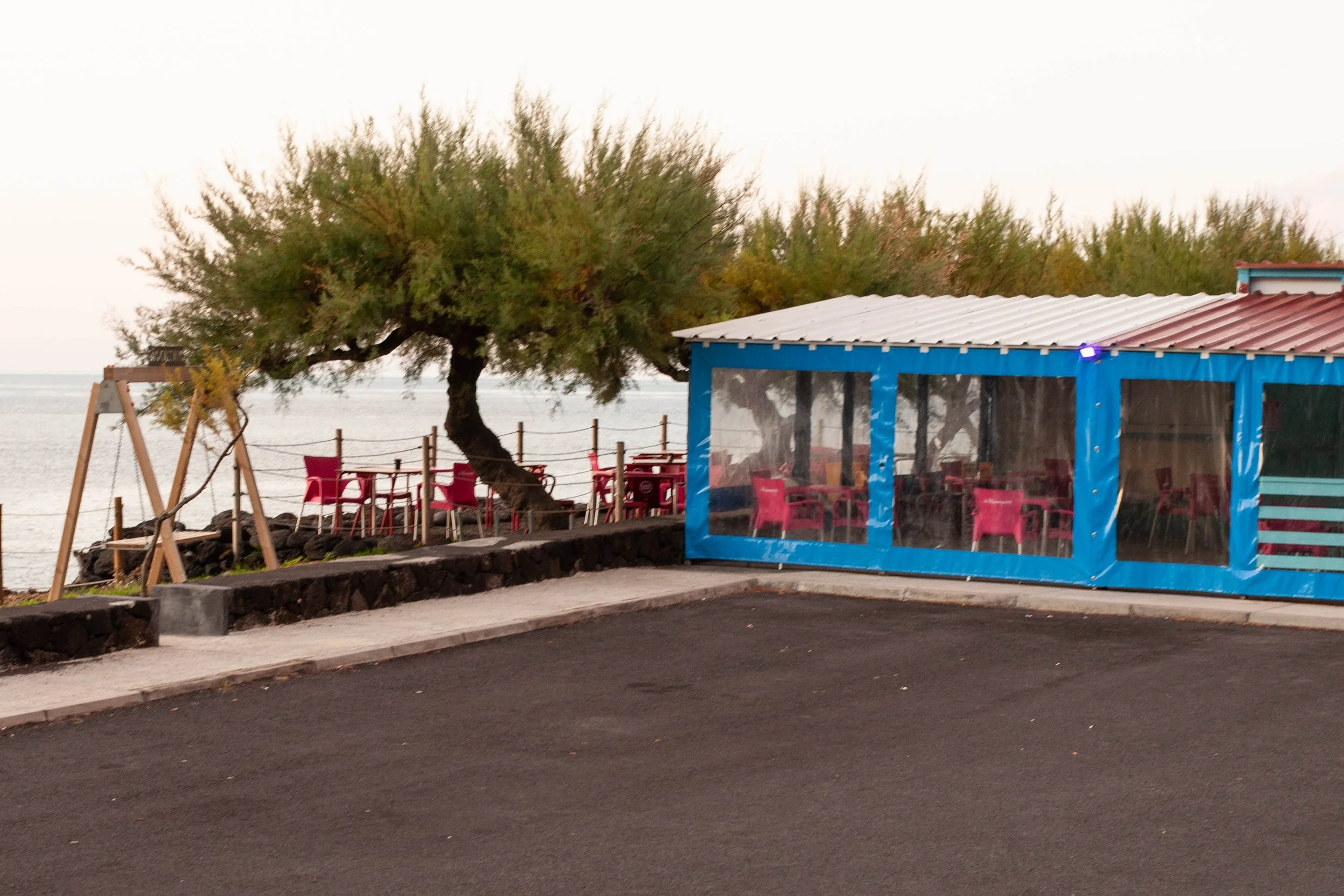
21 The small cafe
On the first night we were startled by the sudden loud calling of gull coming in to roost, after dark. We learned the next day that these were Cory’s Shearwater, (Calonectris) a very rare bird. I tried to estimate the number from the call and think 30 to 50, but that is little more than a guess. They came in to roost, loudly, every night between 9 and 9.30 pm, and were equally loud when they left at around 5 am every morning.
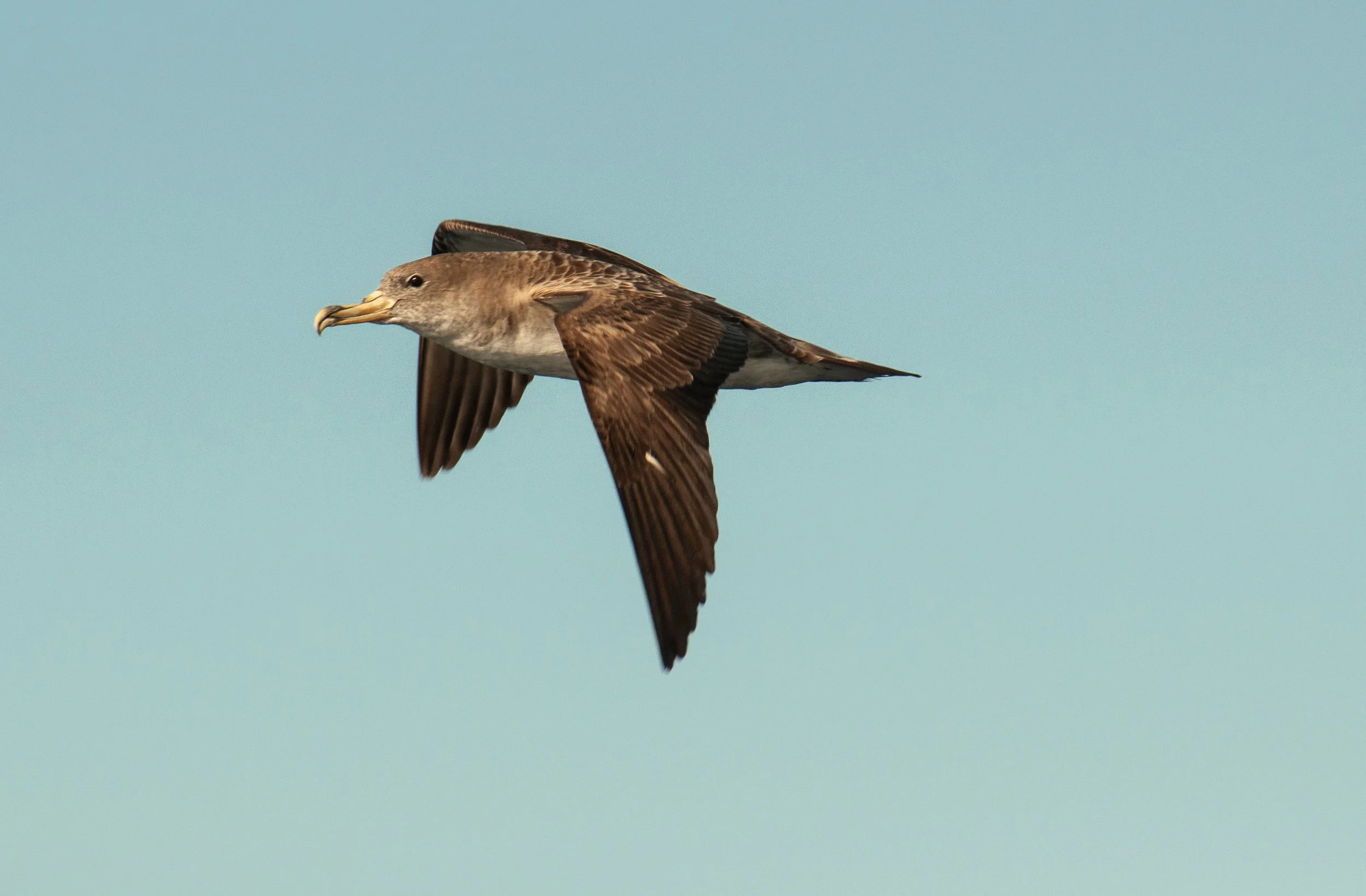
22 Cory’s Shearwater
The volcano Mount Pico dominates the island and is the highest mountain in the Azores, and also in Portugal as a whole, at a little over 2000 metres. We decided that we would drive up to see the crater lakes but day was very overcast, and in the clouds we had visibility of 20 metres or less, not ideal on the narrow, twisting, dirt roads. As we were discover, you have to be lucky to find a day when Mt. Pico is without cloud.
Giving up on Mt- Pico we went down to the coast and Port Lajes, and made our way to 2 whaling museums. Whaling was an important activity in the Azores until it was banned in 1986. The first museum detailed the actual whale hunting and the second, the industrial, processing side of the business. Both were excellently curated and gave a real insight into the importance of the industry to the social and economic life of the islands.
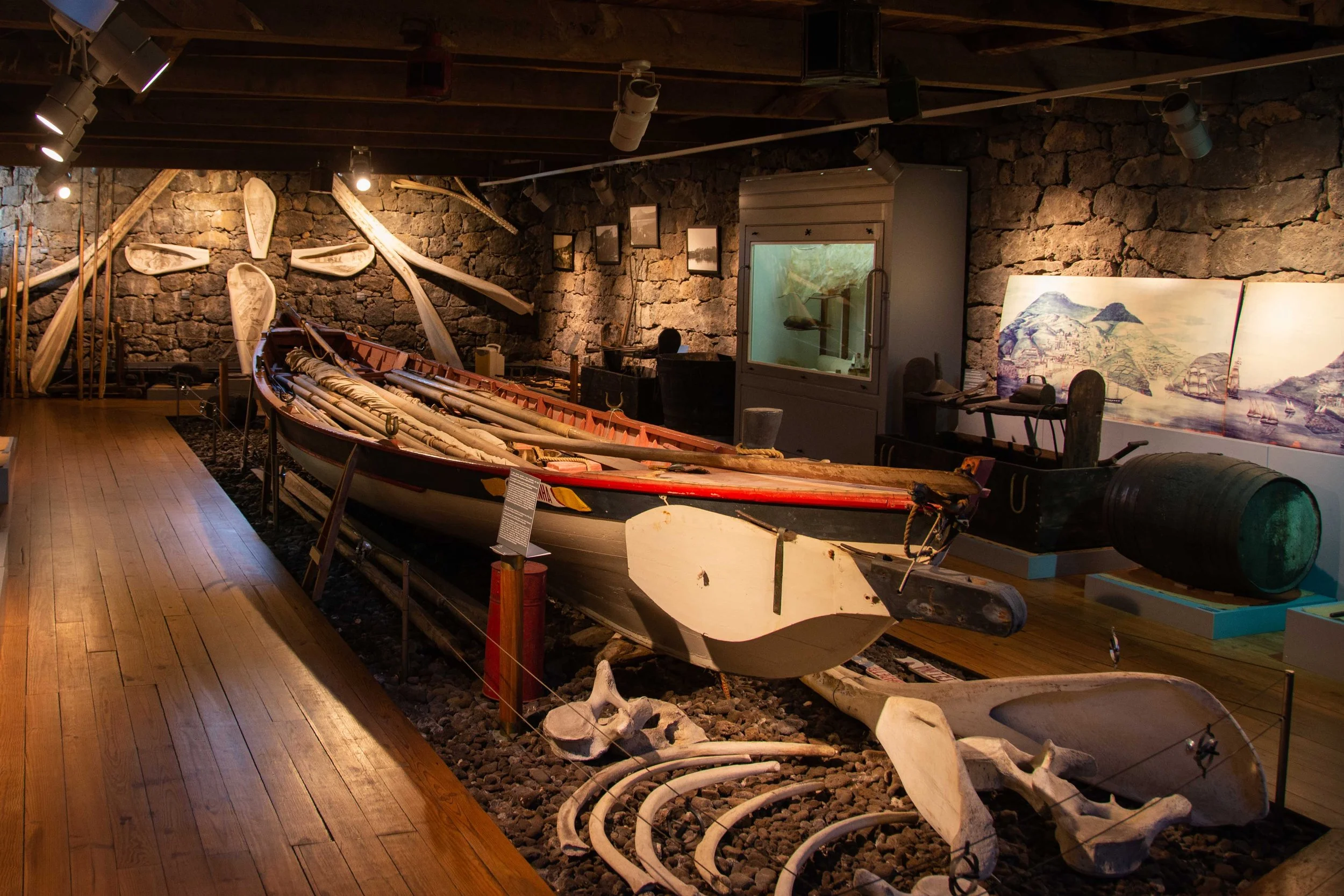
23. A whale boat and assorted whale bones.
While we were exploring Port Lajes we discovered that whale-watching tours left from the port and we decided to book a tour for the next day.
In the morning we were up bright and early to make sure to be on time for the whale -watching. The boat was a medium sized inflatable with about 20 of us on board.
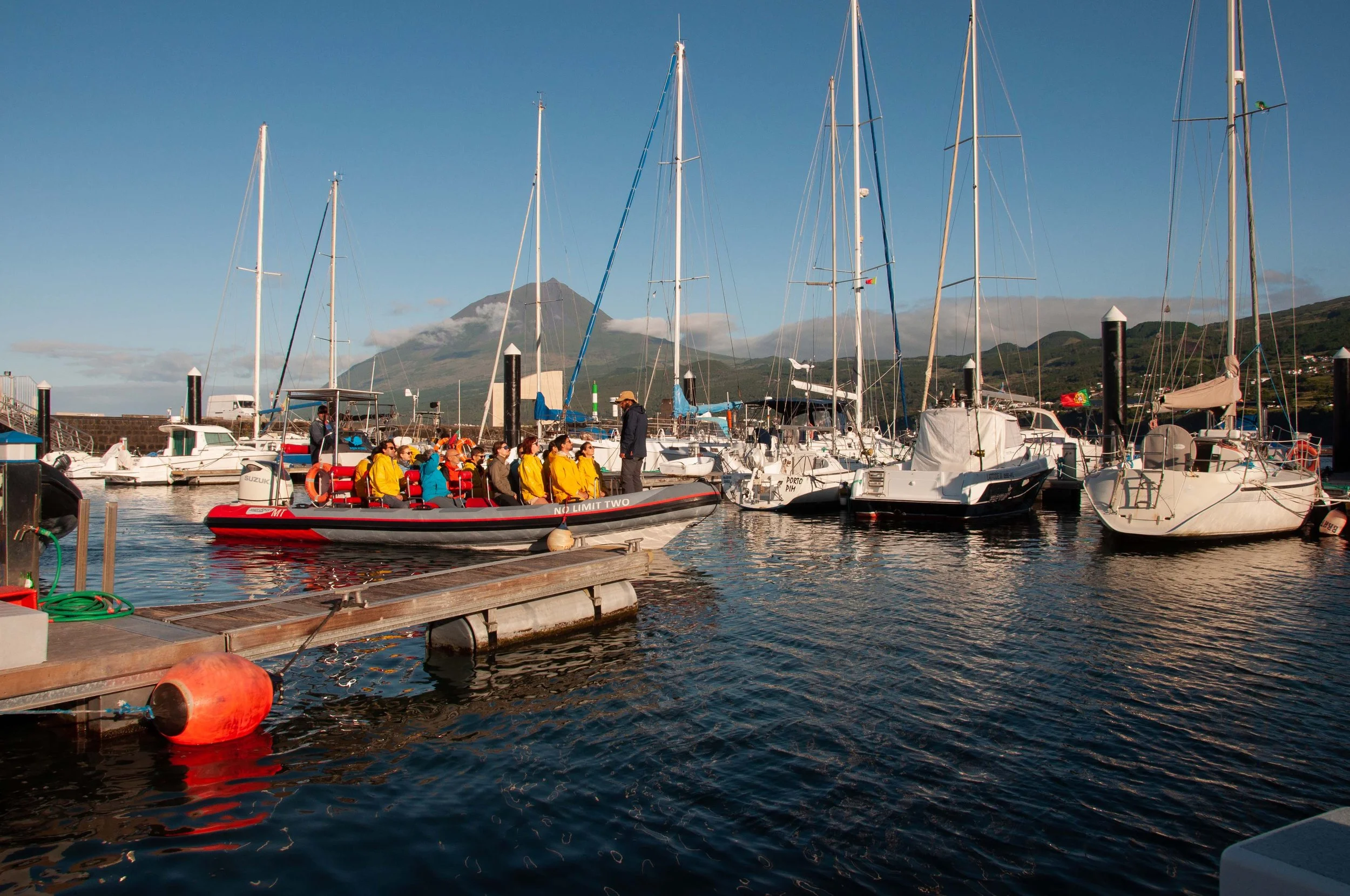
24. An inflatable, similar to ours, leaving port.
We had an excellent day, lasting about 4 hours on the water. At the start the sea was calm, no wind and the sea like glass. We were picked up by a school of spotted dolphins, who obliged us by giving a display of their jumping abilities.
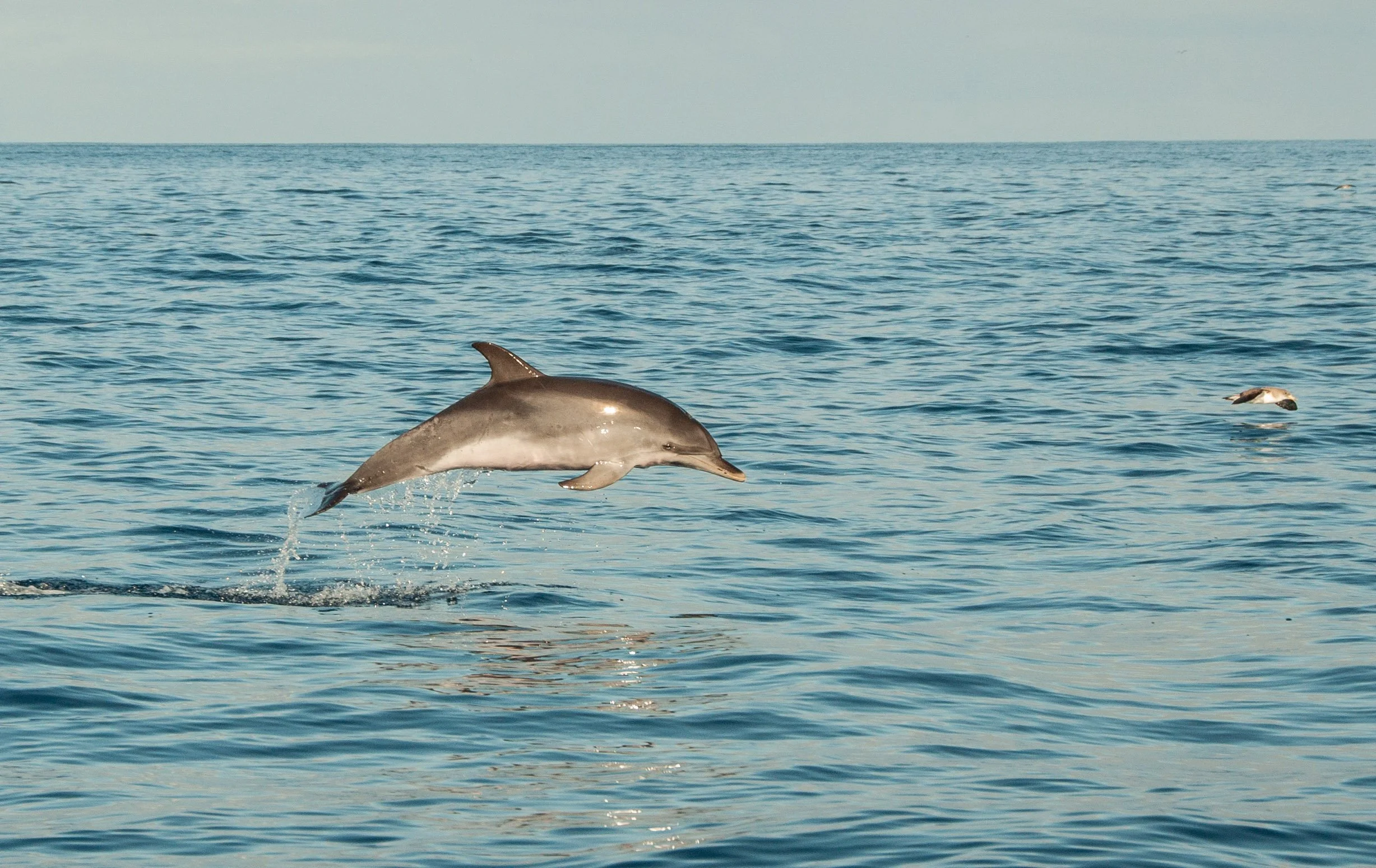
25 A spotted dolphin showing a certain joie de vivre
As we moved further out to sea and away from the protection of the wind shadow, the sea became moderately rough, but not unpleasant. We were very lucky and saw five species of cetaceans. A small pod of 3 sperm whales, one of them a calf and the other 2 females, 1 sei whale, a school, and bottle nosed dolphins and several pilot whales.
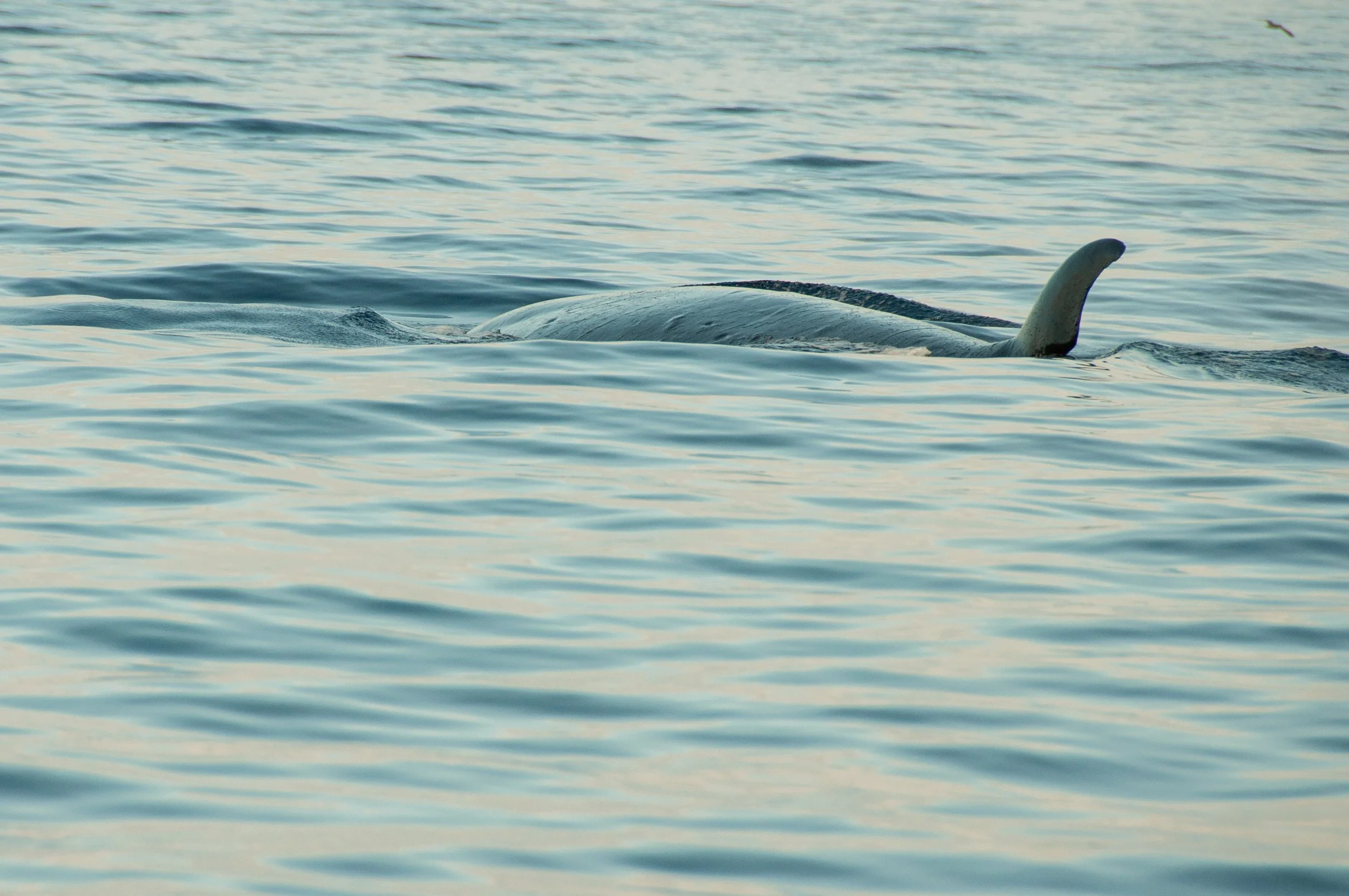
26. The distinctive dorsal fin of the pilot whale
After the trip we went swimming and sun-bathing at the sea pool near the port. An excellent day and it is always good to be on the sea instead of looking at it from the land. There was another red windmill near the swimming area. These are common on Pico for some reason.
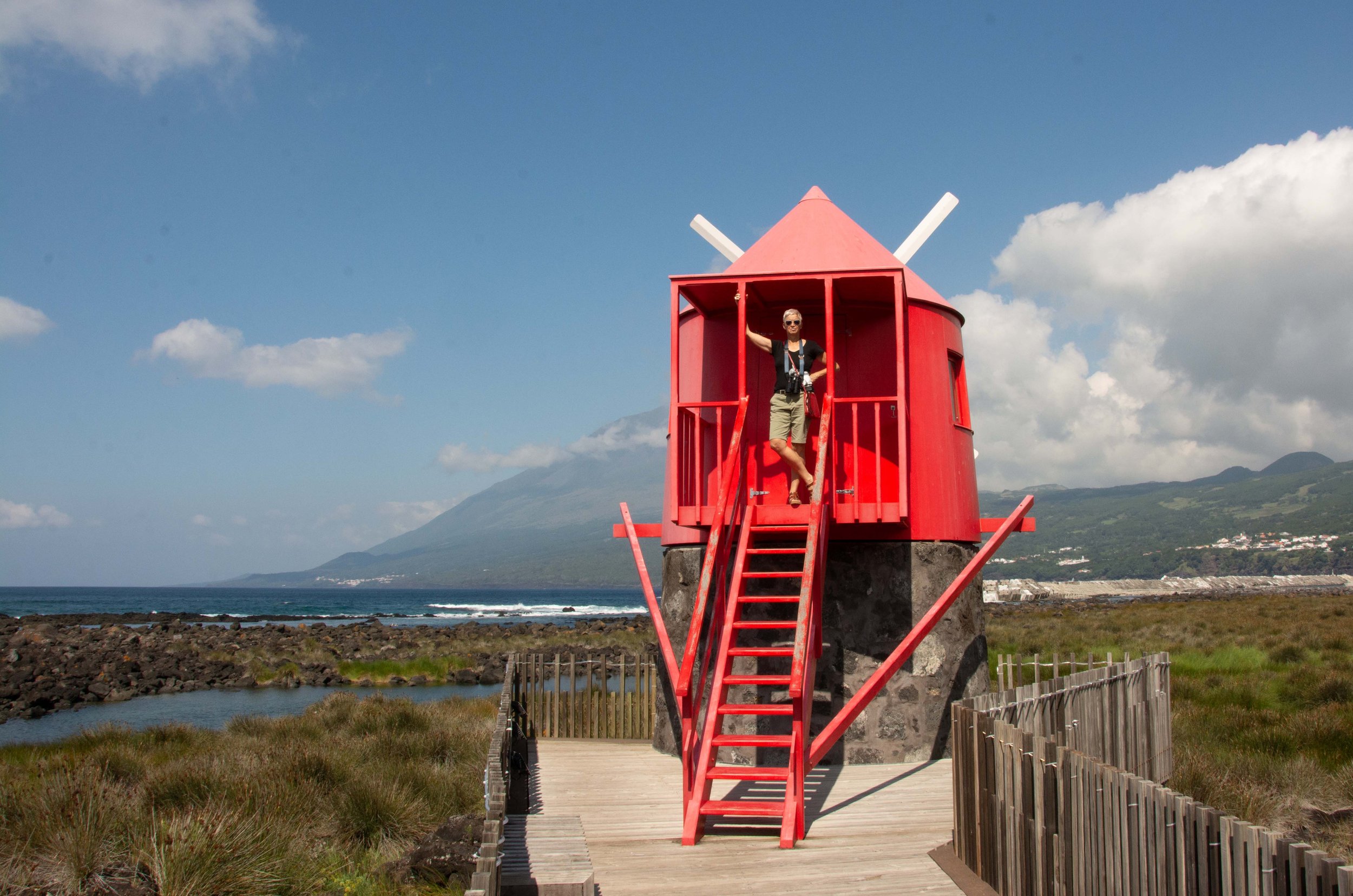
27. We never discovered the purpose of these red windmills which were common on Pico
After we got home I looked the red windmills of Pico up on Wikipedia and discovered they were used to grind the grain, and that Pico was known as the “grain basket of the Azores.”
The next morning we had a late start and while having our coffee watched a spear fisherman swimming close inshore. When he came ashore we saw that he had a number of large octopus in his bag, tentacles as thick as my thumb.
We debated attempting again to drive up to the craters, but the cloud was coming down again so we abandoned that and went to third whaling museum. This was again excellent and was really a portrait gallery of some of the last surviving whalers. The photos had all been taken years after whaling had ceased and the, mostly, men were photographed in their new lives, boat building, farming, or just relaxing in a bar. Really good photographs.
From there we went to the town of Manhenha, the most eastern point of the island. We walked out beyond the lighthouse and a short way along the coast.
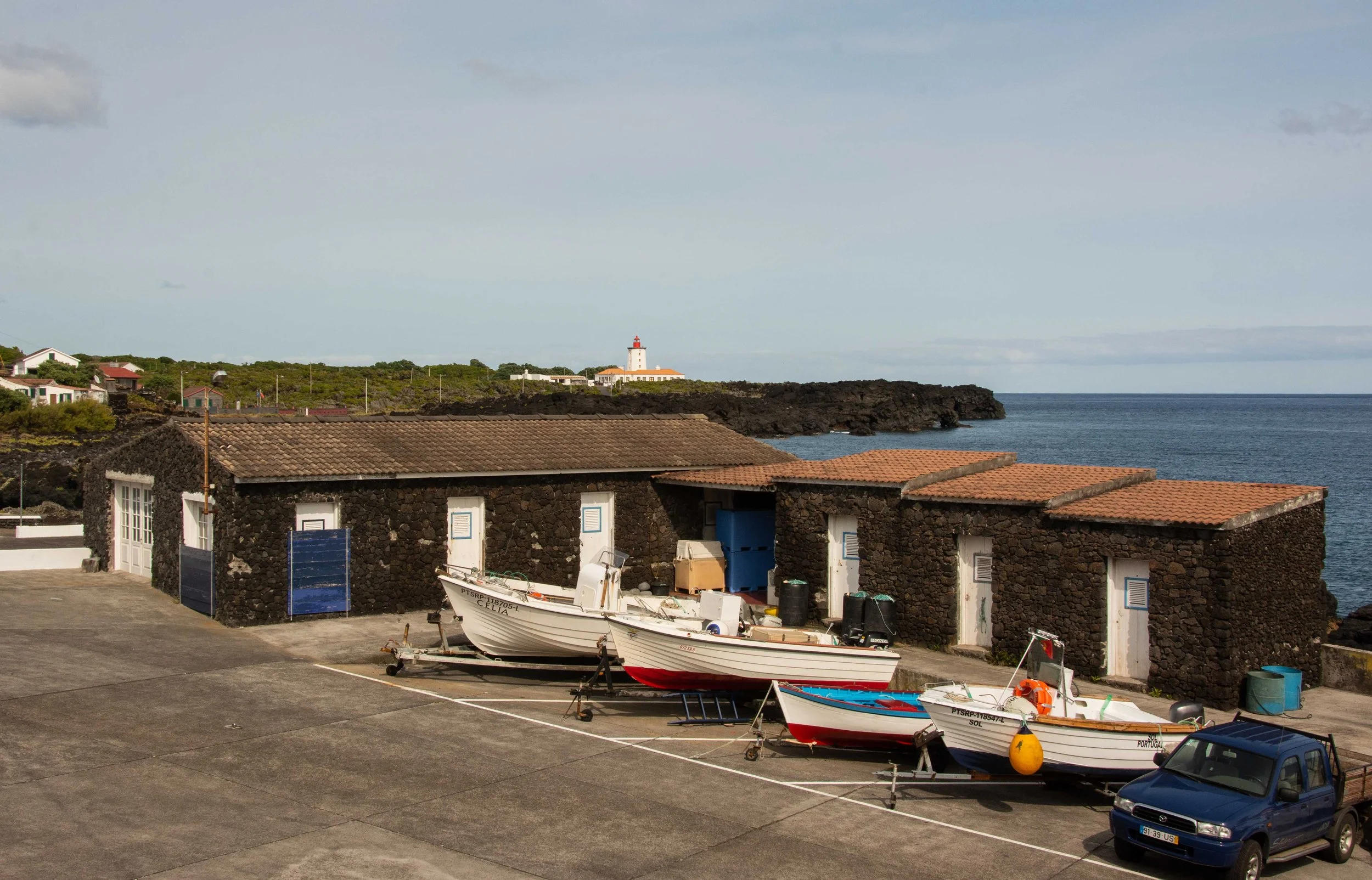
28. Manhenha boat ramp with the lighthouse in the background
One thing that really struck us is how life seizes any opportunity. The rocks there are dry, rough basalt, salt sprayed and yet here and there plants are struggling to assert themselves.
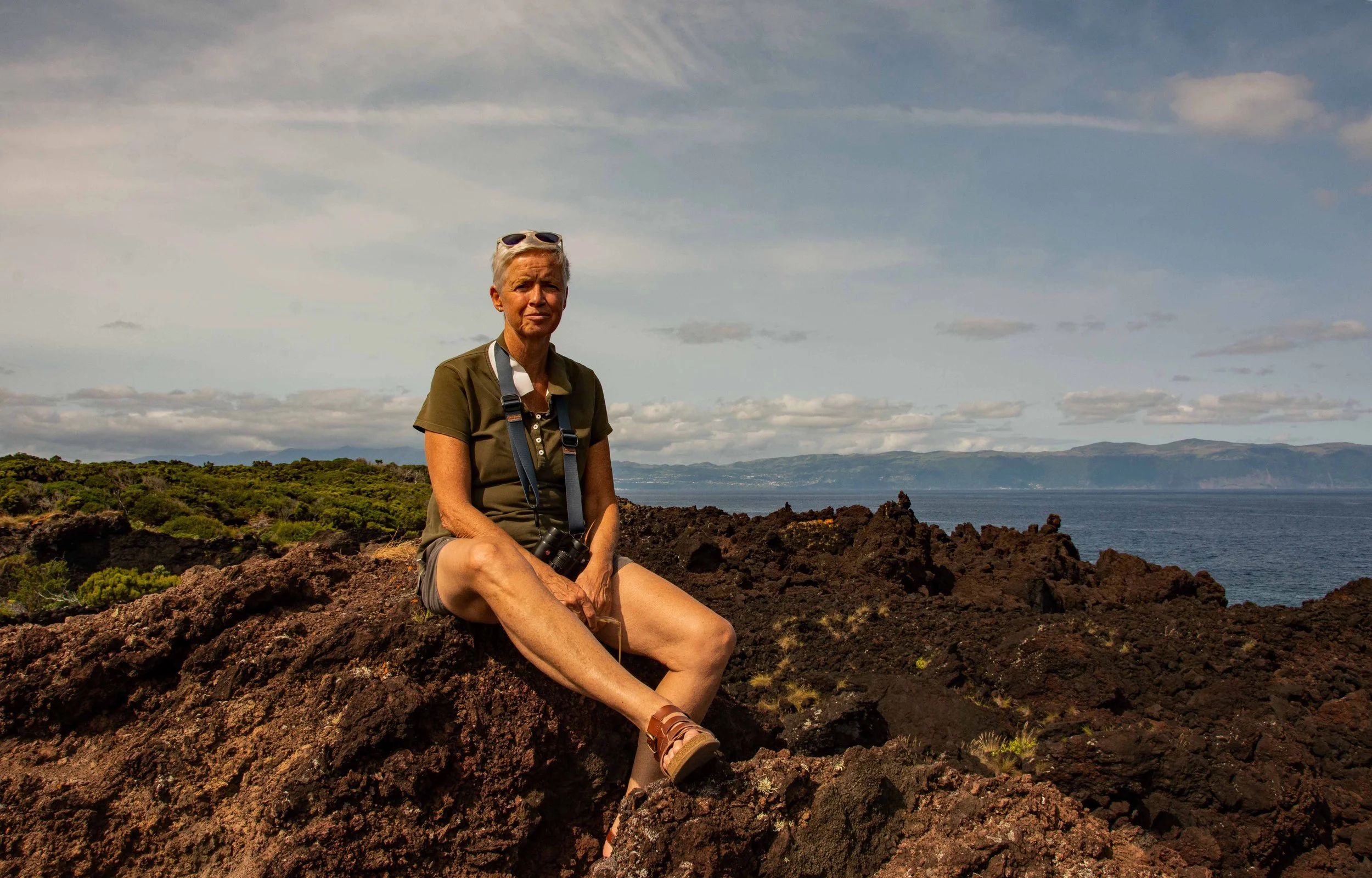
29. You don’t get much more east on Pico, the island of Jorge in the background.
From there we drove on to a museum celebrating the wine industry for which Pico is famous. The vines are grown in small basalt enclosures, no more than a few metres in extent. Each one contains a single vine, grown flat on the ground to protect it from the wind and cold.
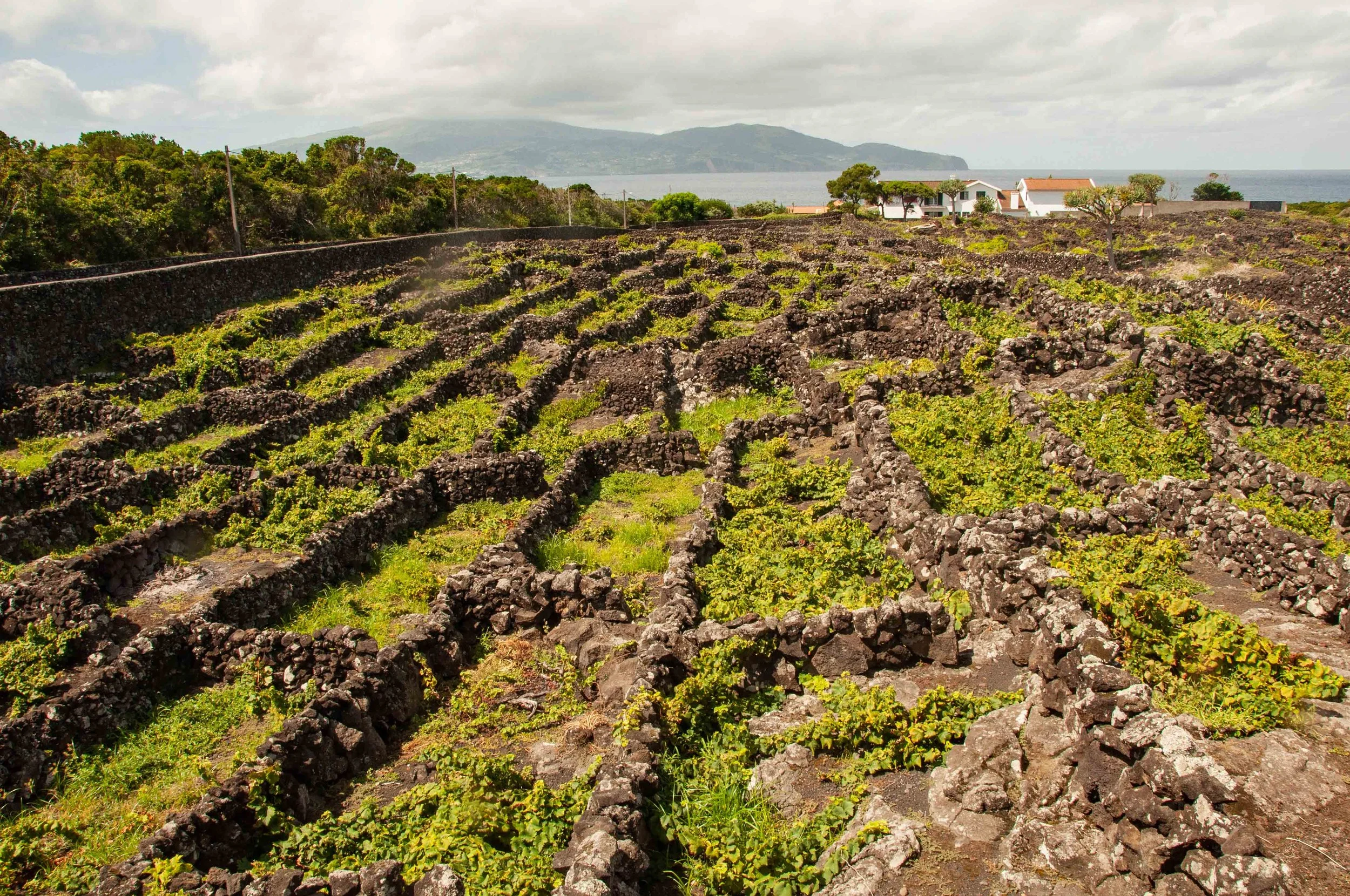
30. The vineyard at the museum, but similar to vineyards everywhere on Pico.
On our last day on Pico the day started sunny and we took the opportunity get to the highlands and the crater lakes.
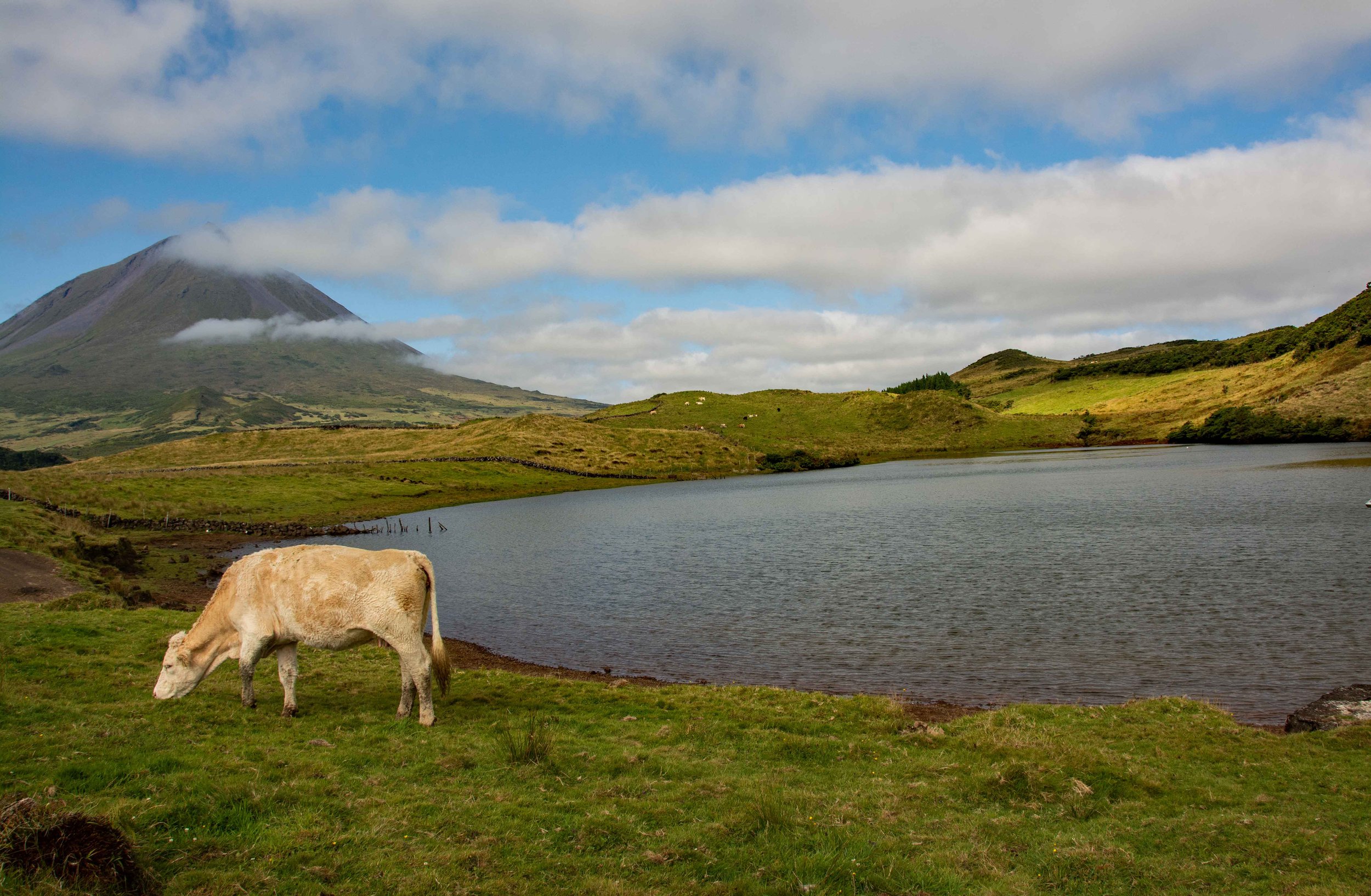
31. On the plateau with Mt Pico appearing from the clouds at last
We had our day on the plateau on the last day of our stay on Pico. We really enjoyed our time there and it was our favourite of the trip. Perhaps because it was our longest time on an island and so we were able to spend more time exploring it, but we found it so interesting and without being overtly a tourist destination, it made being a tourist easy.
From Pico we flew back to Sao Miguel to spend our last few days there.
SÄO MIGUEL, again
We flew from Pico to Ponta Delgada but this time we did not go to the old town. We had a booking at a small resort in the town of Furnas. We did a bit of supermarket shopping in Delgado before driving to Furnas, beer, wine, some more solid food. After 10 days of quiet, rural life we found central Delgado and the mall a bit stressful, so we didn’t spend any time there more than necessary.
After stocking up, we headed for the town of Furnas where we were staying in the well named Landscape Centre, semi-detached bedsits. Very comfortable and with an outdoor jacuzzi, a sauna and a small swimming pool. What luxury, after 10 days of travelling, just what we needed.
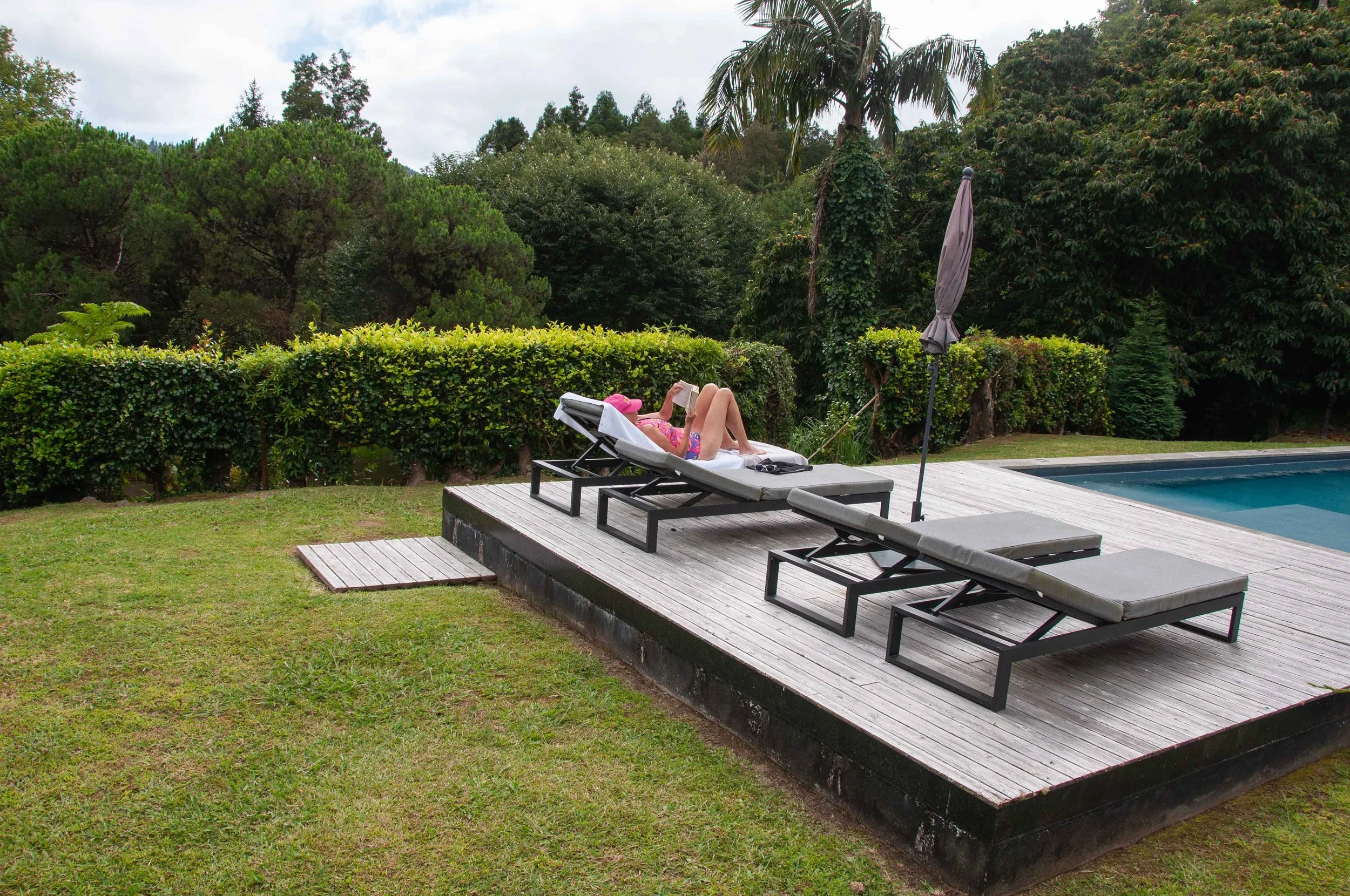
32. We both made good use of the facilities to recharge and relax the pool
In the afternoon we walked about the town getting acquainted. Many tour buses, even though the main tourist season was supposed to have finished. Furnas has been built in a caldera and there is hot water bubbling out of the ground and fumaroles with boiling mud at the edge of the urban area.
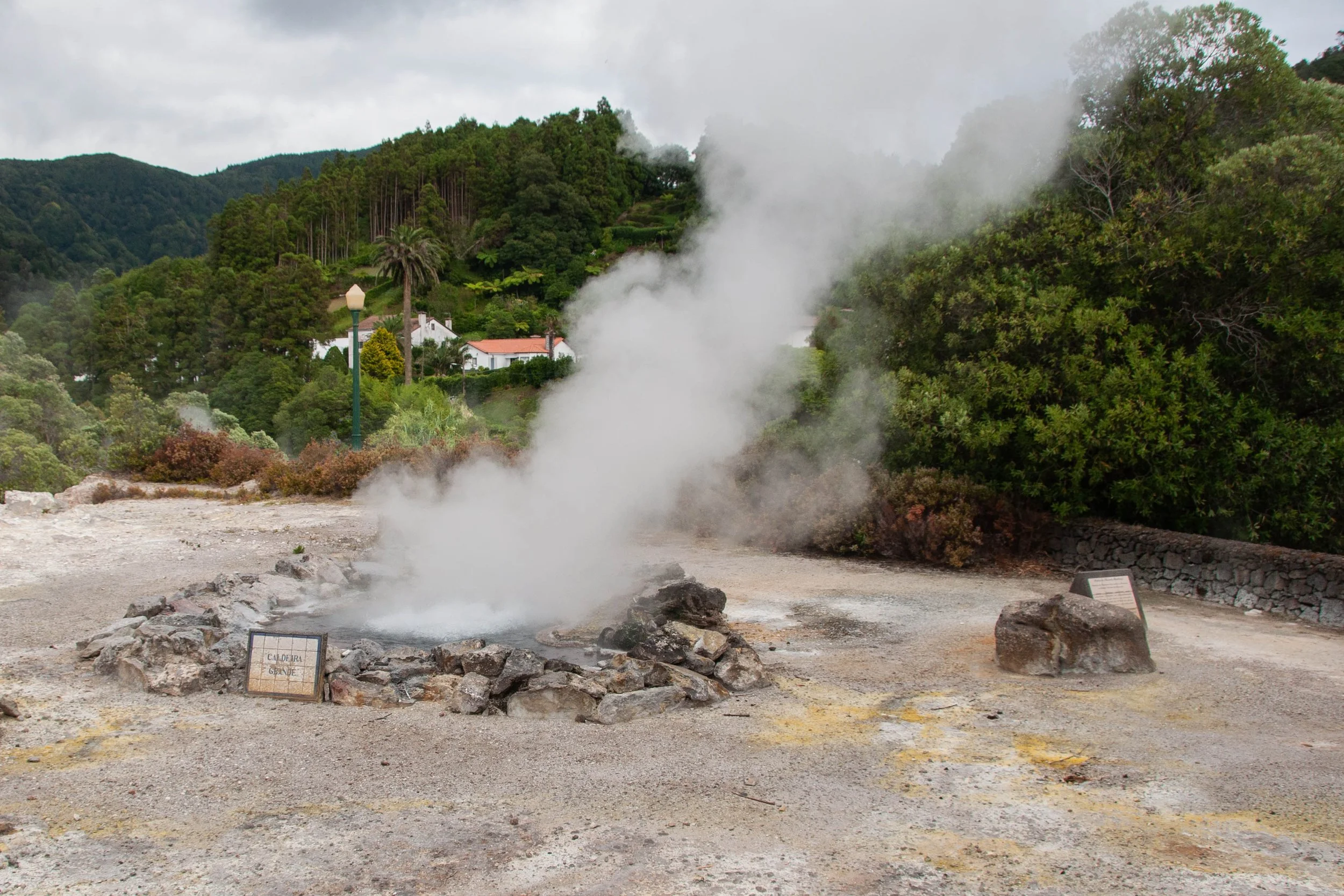
33. A steaming fumerole, Furness is famous for them and the volcano there is considered to be still active.
We walked the 9 km around the volcanic lake and found an excellent environment centre explaining the geological history of the islands. Relaxed back in our room for an hour or so and then drove to the top of the caldera to get a good view of the lake and the extent of the caldera huge, about 7 kms diameter.
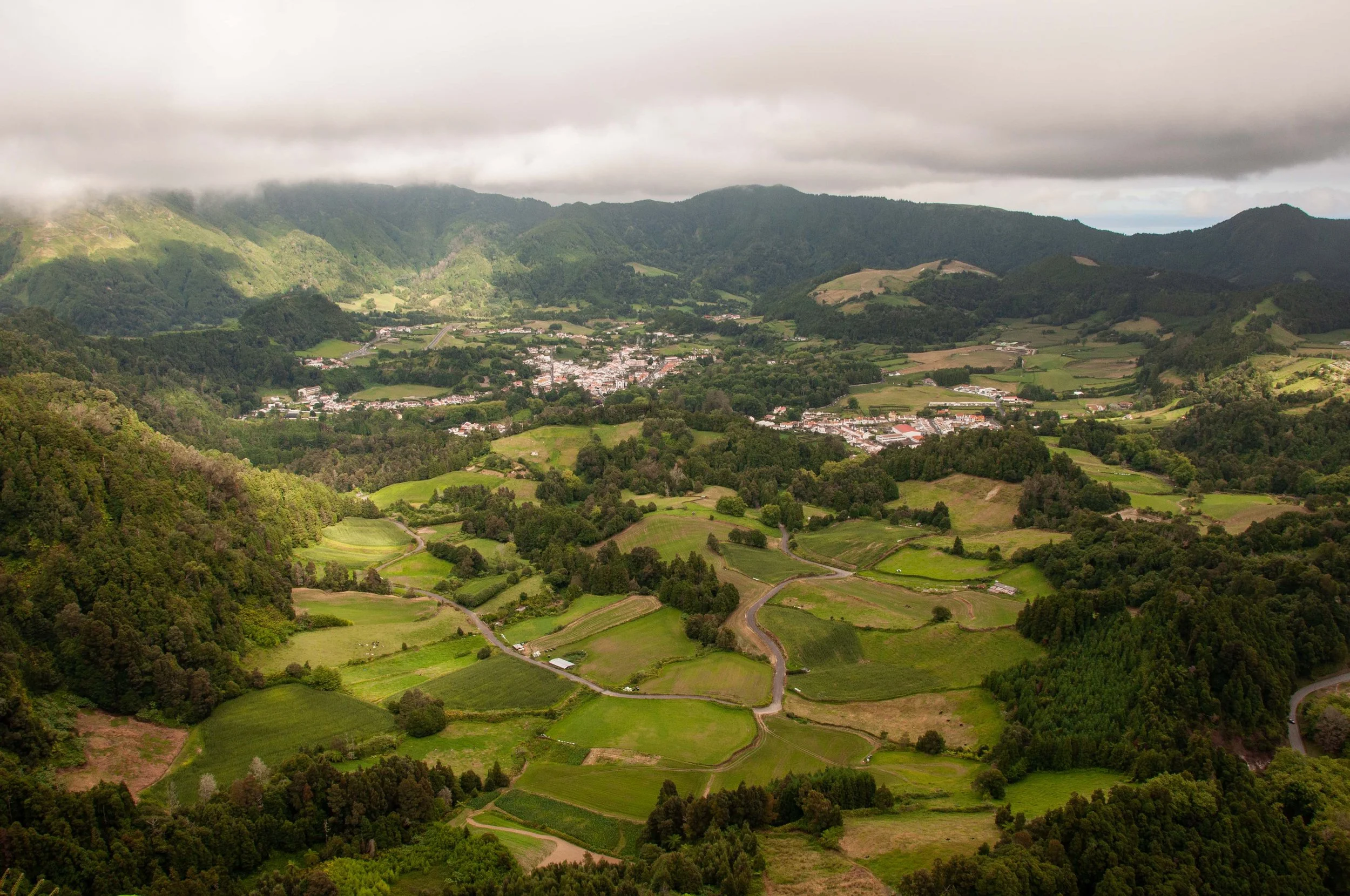
34. Furnas from the rim of the caldera
The next day we went searching for the Priolo, the local name for the Azores Bullfinch, a rare and endemic bird found only in the laurel forests on the north-east mountains of the island. This was also the first and oldest volcano of what would become São Miguel as other volcanos developed.
On the way we stopped at Povoaçä - long and twisty road down. Lots of terns and a lovely little harbour, and had a short walk about the town. Very pretty little town, but seemed very geared toward tourism although there did not seem to be many there at the time. End of tourist season?
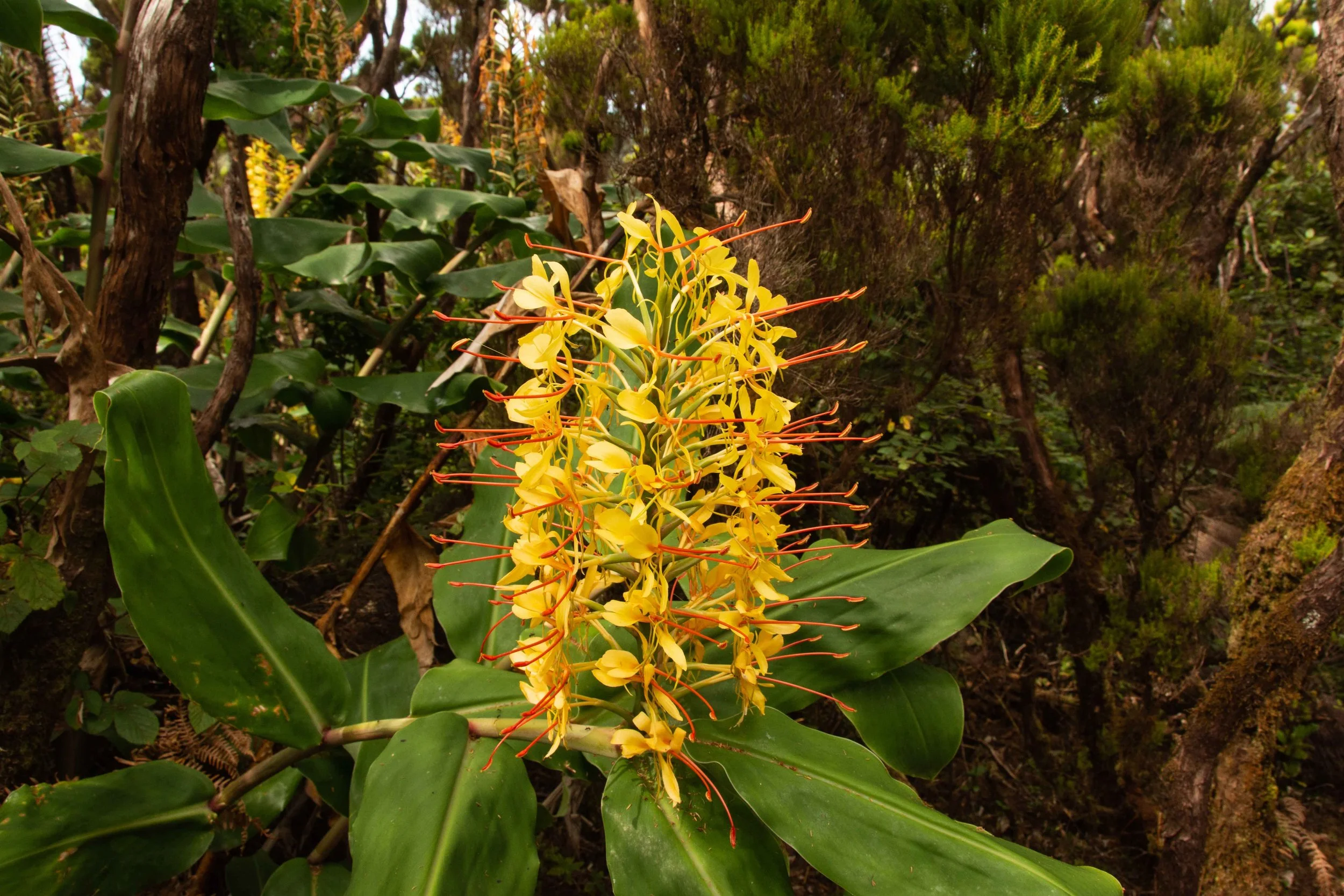
35. The wild ginger plant, a beautiful flower but a pest on the islands
The enthusiastic staff at the Priolo Interpretation centre gave us a good introduction to the area, and we discovered why the island is covered in hortensia and ginger plants and so many other introduced species. Children of rich were sent to study in Britain, and there they saw the gardens in UK. When they returned they tried to establish something similar on the Azores. They were only too successful and the plants thrived and went feral, and basically took over the islands. Superficially very pretty but an ecological disaster. 85% of the vegetation is of introduced species.
We walked in a promising area as advised by the staff at the centre, but failed to find the Priolo. The day was overcast and misty in the mountains and this may have something to do with it. To make up for our failure I bought the T-shirt instead. Been there, failed and bought the T-shirt instead.
From Furnas we drove across the island to Ribiero Grande where we to spend our last days on the Azores. We were too early to check-in and so we visited the Tobacco Museum in the town of Maia. Again, excellent. We were only going to pass the time but found it really very interesting, well laid out and a good introduction from the staff member, on duty by herself on a Saturday morning. The coast at Maia is particularly rugged, with the waves smashing onto the base of the sheer cliffs.

36. The cliff-tops of Maia
The hotel, when we checked into it, we found very luxurious, not somewhere we would have booked for ourselves. Indoor and outdoor pools, gym etc. We had a room overlooking the sea and, after a walk on the beach to stretch our legs, were able to sit on the balcony with a glass of wine, and watch the surfers in comfort.
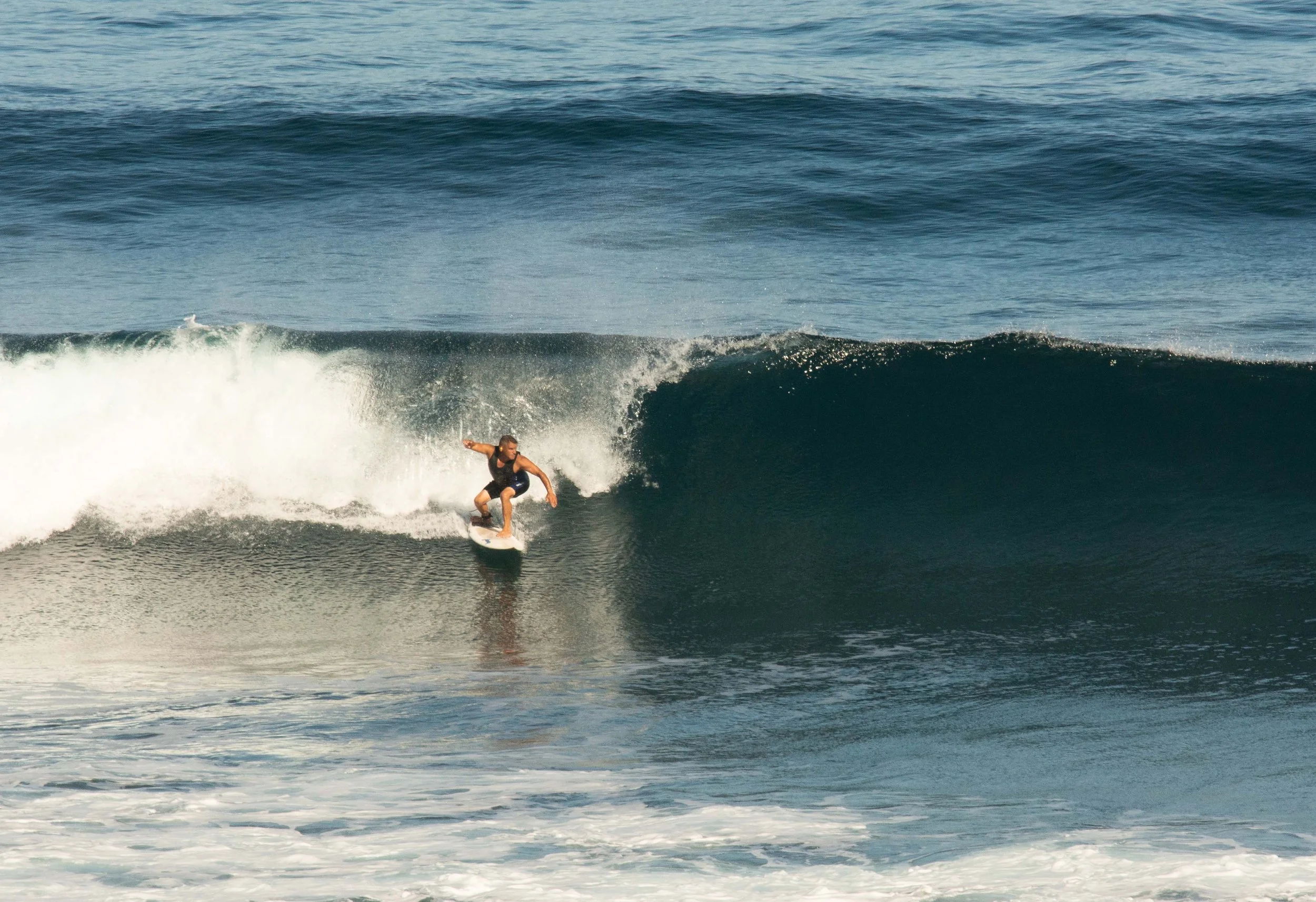
37. Ribiero Grande is well known as a surfing centre, and surfers were out literally from dawn to dusk
After we had reconnoitred the what was on offer at the hotel we went for a walk-about the immediate area and we found the ARQUIPÉLAGO – CENTRO DE ARTES CONTEMPORÂNEAS. There was an interesting exhibition of traditional craftwork, but we were told that there was an exhibition opening later that afternoon and we decided to come back the next day to see it. From what we could see around the barriers it looked interesting.
In the evening we went out to a family run fish restaurant for dinner. Truly excellent. I had grilled blood sausage with grilled pineapple. Amazing!!! And Ursula had an enormous plateful of what they called grilled mackerel, more like the large pilchards we get in SA. 16 of them, and a good fish soup. I am sorry to go on about the food everywhere, but the food, especially the fish, was excellent wherever we went.
Went back to the Art Centre. The exhibition was of the life’s work of an artist we had never heard of, our ignorance, Lourdes Castro.- born 1931 in Madeira died 2022 in Paris.
We were just blown away. The impression was of a woman who was just bursting with creativity. From her early paintings at art school, which she left after the professor labelled her. work as ‘unacceptable,’ the piece was on display with the professor’s remark scrawled across the top.
She painted, worked with acetates, plastics, fabrics, felts. A wonderful imagination and we really recommend that anyone who is interested should look her up online. We were there 2 hours and left overwhelmed. We could have stayed twice as long.
https://en.wikipedia.org/wiki/Lourdes-Castro
and
https://www.wikiart.org/en/lourdes-castro
After the exhibition we went for a last swim in the sea at another protected bathing area. Lovely.
Day 15
The trip was finally over and the next morning we drove back to Delgado and flew home to Switzerland. Wonderful and memorable holiday. Just what was needed to recharge batteries. Lovely memories and we would love to return and explore some of the other, smaller islands, at some future time.